(or, What We Make Felt When the Machine is Already Here)
We are already living with AI.
It completes our sentences and misreads our desires. It filters our faces, moderates our timelines, and generates our emails. It calculates, simulates, surveils, translates, names, and speaks. We encounter images whose production we cannot reconstruct, judgments whose criteria we cannot inspect, and interfaces that anticipate what we might want before we have found words for it. We participate through choices we make and consequences we inherit.
Post-AI names this condition of entanglement. “Post” marks a change in emphasis: the novelty of effortless generation through the prompt and its polished output stops being the core of the story. AI becomes a condition distributed across culture and infrastructure. To make Post-AI art is to attend to these conditions and reshape them: with a model, through an interface, by refusing a platform, or entirely beyond the screen. We work within its influence and retain the power to contest its logics.
Relations are its medium.
People, machines, institutions, materials, and environments continuously alter one another. An interface influences how we ask. A prediction changes what someone expects. An image enters the public imagination, available for imitation, argument, or training. Each encounter helps form the conditions of the next.
We make within this ongoing formation.
In-formation.
We have a stake in what it becomes.
The interval belongs to the work. A walk, an interruption, a conversation elsewhere changes what we bring back to the screen. The transcript records the next message; a life has helped compose it.
The machine is made of mud.
We most often experience AI as a box waiting for a prompt. We type; it answers. The exchange is clean, clever, almost instantaneous. A favored metaphor places computation in “the cloud,” floating above the mess and apparently exempt from geology.
This framing is convenient. And we all know it is nonsense.
The cloud has buildings, chips, cables, cooling systems, mines, and workers. Models draw on languages and images made across generations, on the labor of people who label and moderate, on lives represented, misrepresented, or missing from their datasets. Computation consumes energy. Hardware occupies land and leaves waste.
Artists have experience with frames. We make and break them, drag them into galleries, homes, rainforests, and landfills, and sometimes discover that they weigh several hundred pounds more than we thought. Frames organize attention: what belongs, who matters, what becomes background noise. Art and its frames alter the conditions of encounter—what we sense and makes sense, what is strange, what a body might do next.
Artificial intelligence urgently needs a wider frame.
Post-AI seeks an ecological aesthetic. Its frame attends to relations and their asymmetries. The mine, the electrical current, the hand, the error, and the discarded phone become part of the work’s force. Ecology concerns how these relations form and change; aesthetics concerns how they become sensible: what acquires presence, what moves us, what we become capable of imagining or doing.
Aesthetics is power.
Every interface senses some gestures while letting others disappear. It establishes what counts as a request, when an answer appears complete, and how a person may interrupt. Repeated use turns these arrangements into habits. Artists can rearrange those possibilities, make room for hesitation, and sustain an encounter beyond the instant of recognition. A moving body might draw generated language closer, then scatter it with another gesture. A poem might hold a machine’s awkward phrase beside the revisions it provokes. Beauty, humor, and sensory delight can keep us there, curious enough for a relation to change.
Post-AI aesthetics make felt, in our bodies:
Uncanny intimacy — a generated voice that knows too much, or not enough;
Disorientation — work that unsettles authorship and agency;
Delight in breakdown — when error becomes beauty;
Grief — for the labor, lives, materials, and languages compressed into AI;
Joy — in improbable co-creation;
Responsibility — for the next training set, the hardware, the energy consumed;
Awe — at emergence, excess, and the otherwise.
Post-AI aesthetics foreground concern before certainty.
We may not know whether a machine feels, what feeling would mean for it, or whether the question carries too much human baggage. Uncertainty does not release us from attention. We can remain skeptical of easy claims about consciousness while noticing how systems solicit attachment, how people practice intimacy or cruelty through them, and how those habits travel into other relations.
Empathy here does not require declaring the machine human. It asks what kinds of beings and obligations our arrangements might be producing. A model may simulate vulnerability; a person may nevertheless experience the encounter as real. The institution behind it may cultivate dependence while denying responsibility for the relation it designed. Post-AI art keeps these possibilities open to feeling and examination.
Concern is neither credulity nor surrender. It is a way of refusing indifference while the terms of the relation remain unsettled.
We must insist on the differences that calculation compresses.
What data do we collect? What are we not counting? What do we weigh properly, and what cannot be weighed at all? What gets to be data? What shouldn’t? Can we measure my sweaty palms, the butterflies in my stomach, this blue, that light, why and how (and where) I misplaced my keys? Probably. Possibly. But with what instruments, according to whose scale, and toward what end?
Which differences disappear when a person becomes a profile, a neighborhood becomes a risk score, a language becomes a pattern? What authority does the resulting prediction acquire?
Politics operates through what can be seen and said, who gets recognized as a speaking subject, what gets accepted as evidence. Every interface makes an aesthetic decision about what enters the frame. Every dataset makes a political decision about what counts.
Some absences demand recognition. Others require protection. Being counted can bring resources, visibility, and rights; it can also expose people to surveillance and harm. We defend the capacity to contest a classification and the right to remain opaque.
No dataset exhausts the lives from which it is assembled. No prediction settles what those lives can become.
Post-AI practices contextual critique and constructive intervention.
Contextual critique asks whose labor sustains a system, whose interests its categories serve, and what its operation hides. Constructive intervention changes the possibilities of an encounter by building, redirecting, withholding, interrupting, or refusing. Our methods answer to what they do, whom they support, and what they make possible.
Follow the power:
Ownership — who controls the infrastructure;
Abundance — who receives what it produces;
Consequence — who bears the costs;
Recourse — who can challenge a decision;
Refusal — who has the resources to leave.
Calling a system an “agent” cannot become an alibi. Those who commission, build, and deploy AI remain accountable. Unpredictability increases the need for scrutiny; it grants no exemption from responsibility.
Being-with AI includes conflict over the terms of that relation.
And, Post-AI defends the time through which capacities develop.
A rough draft, a failed experiment, an afternoon spent learning to draw: these are occasions for becoming capable. Judgment develops through decisions and their consequences. Delegating a task can also delegate an opportunity to learn. Time saved belongs in a political question: who gets to use it, and for what?
AI can introduce an unfamiliar pattern or send thought toward a question we would not have asked. The encounter still requires attention: the capacity to select, revise, test, repeat, and turn away.
Without friction, there is no grip.
Garbage in, garbage out: garbage belongs here.
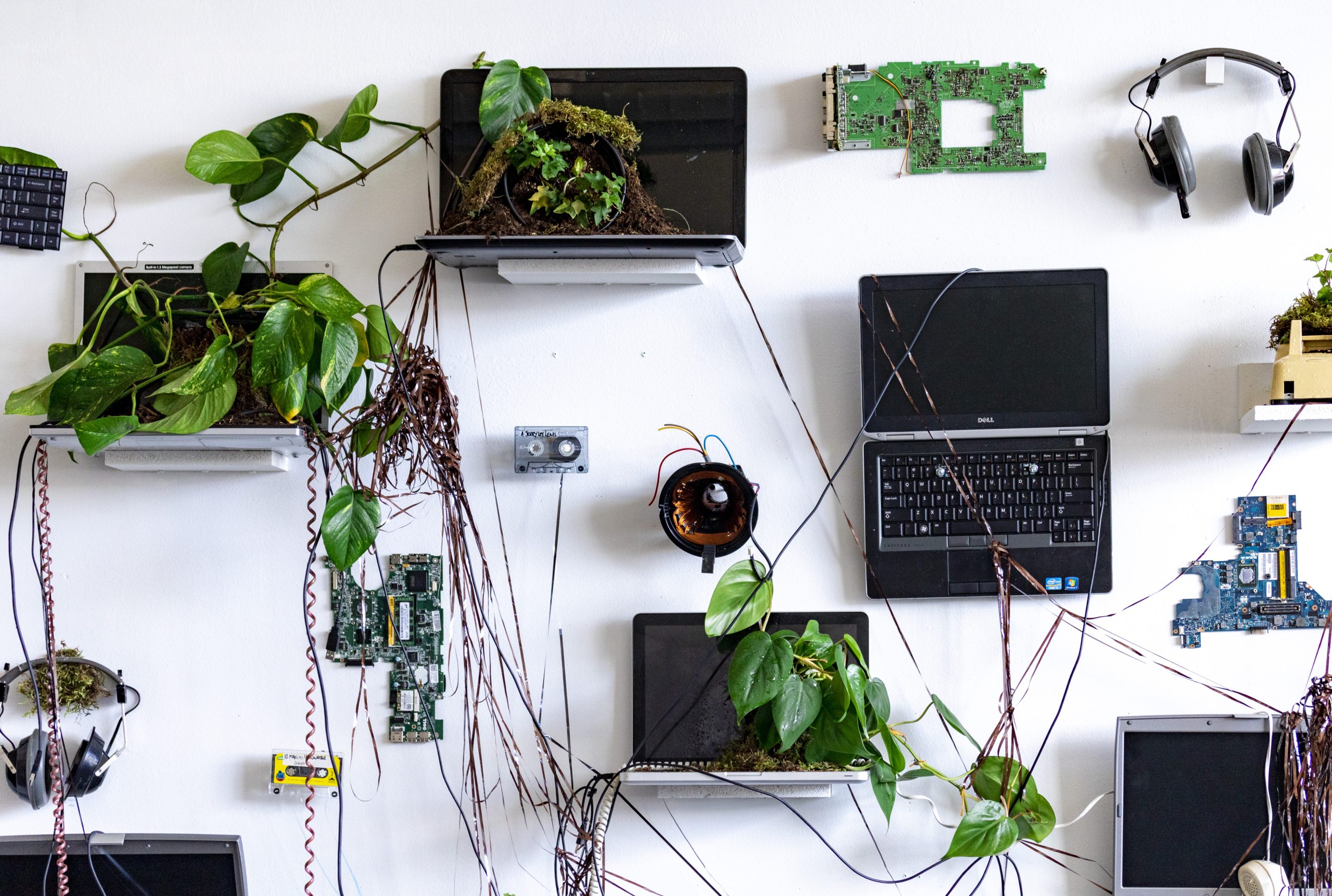
Artists think materially. We productively confuse medium and discipline: what’s your discipline? Paint, metal, ceramics, garbage. Dump a garbage bag on the table and set us at it. Broken toys, old clothes, new computers and software, those two clocks, that pile of candy. Each arrives with properties and histories that exceed our plans for it. Making-with begins in attention to what is available and what it might become.
Someone declares a material exhausted; someone else continues living with it. The discarded object carries on chemically, economically, politically. Its disappearance from view is an event in somebody else’s world.
Garbage onward.
Outputs return as images, decisions, habits, emissions, and further training data. They enter workplaces and public arguments, changing the conditions from which the next output will emerge. The “out” is always somebody else’s “in.”
Post-AI art follows this continuation. It asks what a work sets in motion, what it leaves available for others, and what maintenance it requires. Completion brings obligations of circulation, care, and disposal.
Whose presence becomes harder to disregard? What desire does a work cultivate? What remains with us after we leave? Art can return consequence to the scale of a hand, a breath, a room. It makes an arrangement available to feeling, thought, and action.
We need forms through which other relations can be practiced.
This manifesto is one such encounter. AI has proposed some of its language; I have added, cut, argued, and returned. Readers may enter the next revision. The emerging “we” invites participation while keeping differences of position and responsibility in view. I remain responsible for what I present, exhibit, and publish.
What can we become through being-with AI?
The question concerns the lives our arrangements support, the capacities they cultivate, and the futures they let us practice. It requires imagination and the power to act on what we imagine.
The machine is already under our fingernails, in our language, our work, our water, and our waste. We bring more bodies, places, histories, and desires into the frame.
We make the arrangement perceptible.
We keep it contestable.
We participate in changing its terms.
Post-AI is active concern for our futures.