Weekly, in-progress reflections and experiments: thinking -through and -with.
-
Between Students: “Charging” at KSE Gallery
artists and engineers asked to write manifestos about machines, then make something that has to stand up in public
This between post doesn’t extend the argument of the Posts so much as point to somewhere the argument is being lived: a classroom, and a gallery. Fair warning: I’m going to brag about my students a little. They’ve earned it.
This fall I’ve been teaching the NMDSI-funded Crafting AI: Artists, Archives, and the Future of Creativity, a cross-listed studio for art and design students and mechanical engineers, graduate students included. We opened by saying: this is not a class about artificial intelligence. It’s a class about what happens to creativity when intelligence becomes a material. We have always become more human alongside our technologies, and the semester moves through that idea in stages: thinking-with, seeing-with, making-with.
Practically, that meant “prompt scores” and rewrites, small custom image models trained on students’ own archives, fine tuning LLMs and working with retrieval, video studies that mostly taught us what video gets wrong, and a lot of critique. It also meant a manifesto. Every student wrote one in September, revised it in October, and was asked to let it set the rules for what they would show. This week they show it.
Charging
The students are part of Charging, UWM’s Art & Technology exhibition at Kenilworth Square East Gallery. Alongside us are several other classes from UWM’s creative technologies studio discipline, with work in creative electronics, game art and design, generative projection, time-based audiovisual environments and kinetic sculpture. The show is about energy: the charge of cultural, ecological and emotional life in a world that keeps getting more technological.
Our corner of it is a little odd, in the best way. There is a framed collage, a wall of small family-photo frames, a playable journey from a jet engine down to its atoms, a hand-built frame designed to be taken apart, a screen-printed bandana and t-shirts, a 3d printed creature sculpture watching its own making-of video, screens nested in coral-like sculpted frames, and a tall black monolith that looks back at you. Not much of it looks like what we think of as “AI art.” That was more or less the point.
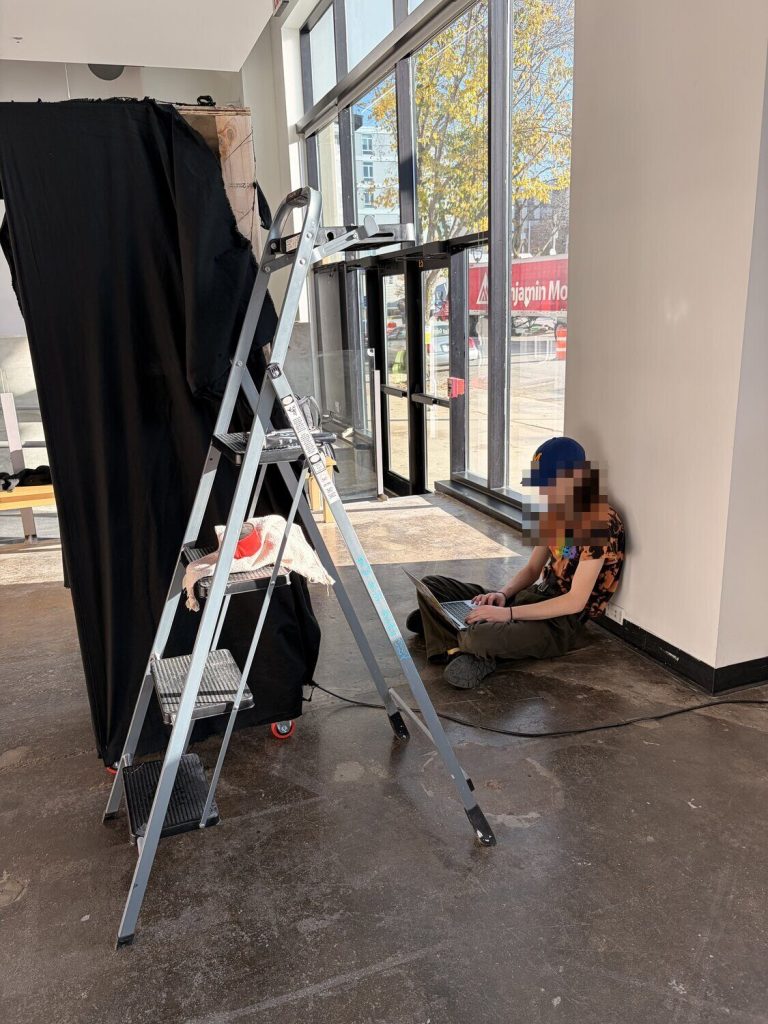
Install day at Kenilworth Square East. Not much of it looks like “AI art.” That was more or less the point.
Three works
Mona Said, WHAT WE CARRY. A 20 × 30 inch matte print in an antique-style gold frame: a scrapbook collage of AI-generated images, torn paper and layered textures. Cultural roots tangle with cultural chains. Olive branches, cedar outlines and kuffiyeh patterns sit beside a rotary phone and an open book. Mona never asks the machine to argue about identity for her. She uses it to generate fragments, then does the arguing by arrangement, deciding what touches what. Her test this month was entirely physical: does the print sit in the frame, can the Arabic be read at three feet, will the wall take a nail. It does, it can, and we’ll find out at the show.

Mona Said, WHAT WE CARRY, 2026. AI-generated images, digital collage, matte print, 20 × 30 in. Harry Smith, Jet, Atoms, and Everything in Between. Harry is a materials engineer who says he can’t draw. His piece is a real-time 3D application on a 27-inch screen with a game controller. You start at a jet-engine combustor dome, watch it printed layer by layer in metal powder, then zoom through grains, cells and atoms, more than nine orders of magnitude. The grain structure is measured data from a real printed sample; the stress view is his own simulation. A colored bar beside the image tells you, at every scale, whether you’re looking at something measured, designed, illustrated or computed. Claude wrote the code to his direction, and he says so on the wall. I love how he ties art and design to his advanced research degree.
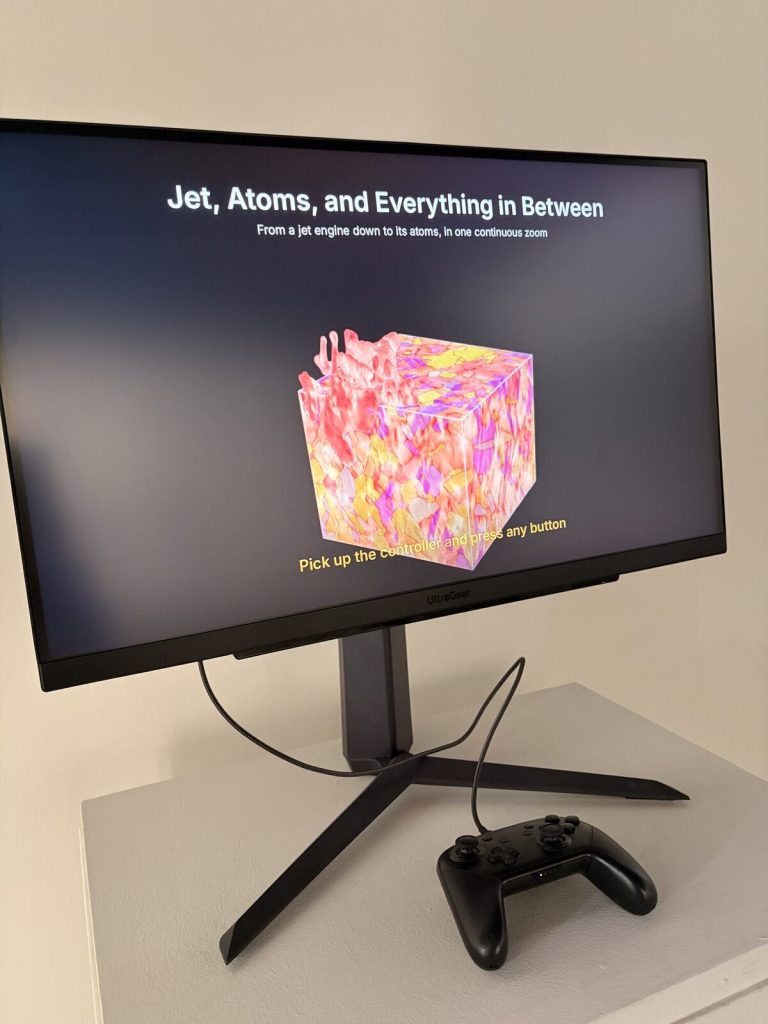
Harry Smith, Jet, Atoms, and Everything in Between, 2026. Real-time 3D application, game controller. Más Mexican. One Mexican-American student (he asked that his name stay off it) gave an image model an AI-generated photograph of a young man on a snowy Milwaukee street and one instruction, over and over: “make it more Mexican.” Twelve images later he is buried in sombreros, serapes, sugar skulls and papel picado, and his face hasn’t changed. The images hang in small frames, printed like drugstore snapshots, so the sequence reads as a family album that slowly turns into a costume shop. A final panel color-codes every symbol and gives its actual origin. His wall text ends where the work does: “Mexicanness isn’t a costume. It’s history.”

Más Mexican, 2026. AI image sequence, 12 framed prints (three shown). 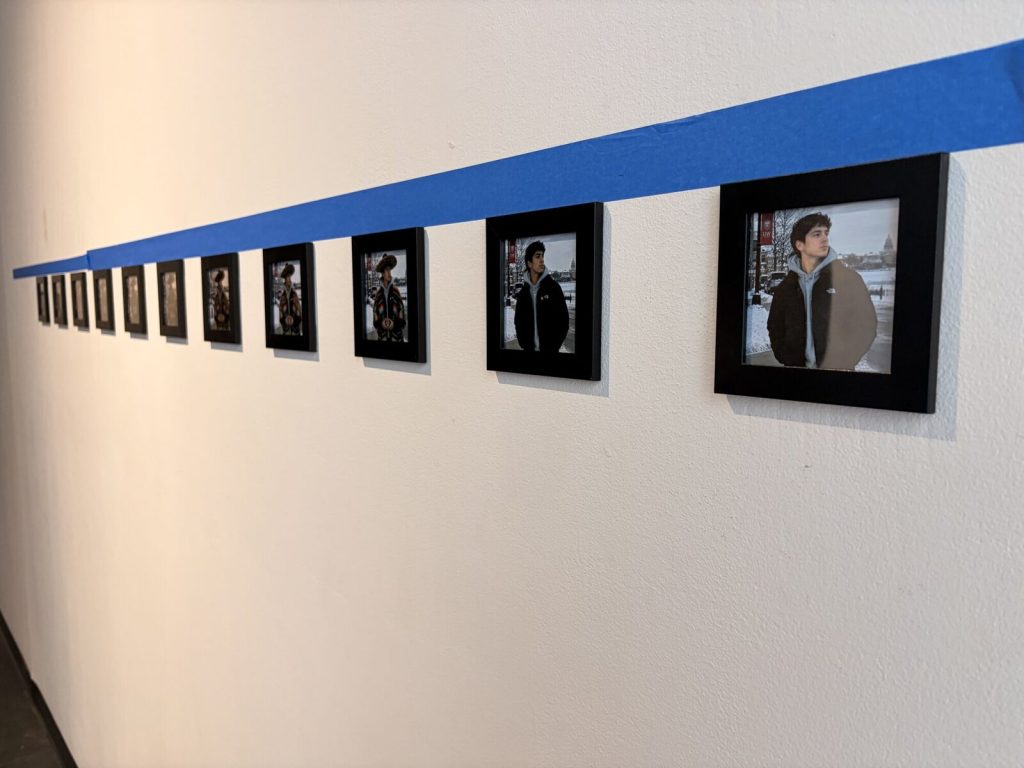
Más Mexican, 2026. AI image sequence, twelve framed prints, on install day. Also on the walls
Andres Benitez’s colored-pencil drawings, fused by an AI pipeline into one landscape that slowly comes alive as an animation on a digital frame, hang beside the original drawing.
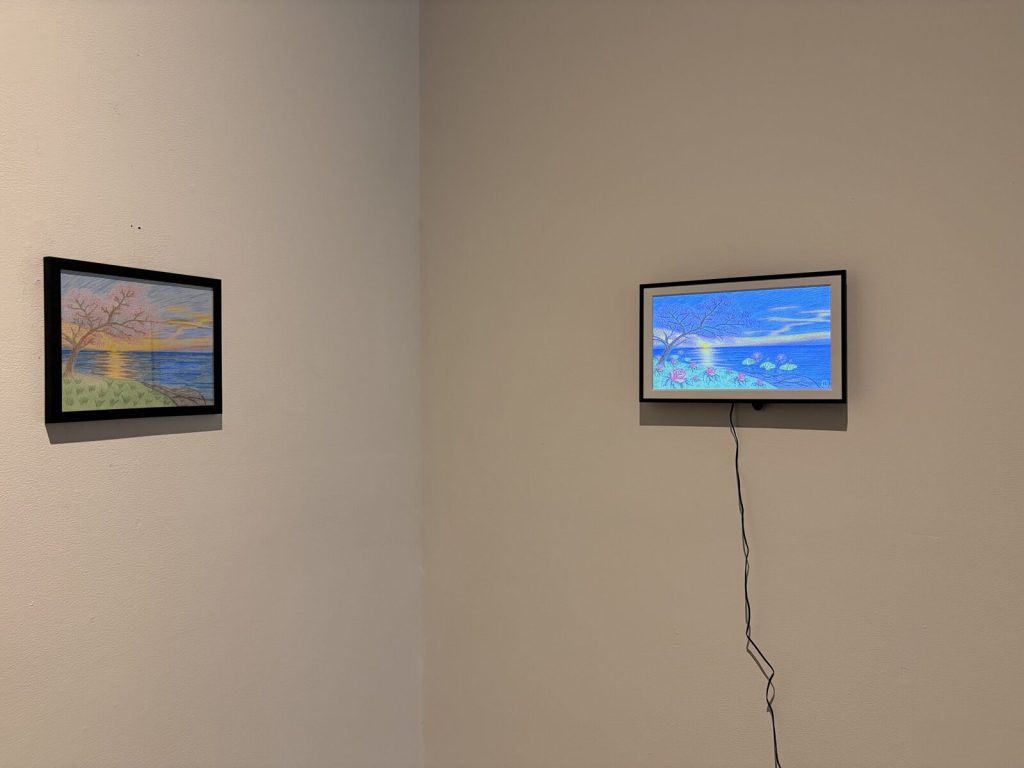
Andres Benitez, Where Drawings Fuse and Come Alive, 2026. Colored pencil, AI image and video, digital frame. Michael Klier’s manifesto is printed as an engineering drawing in a carved burnt-ash frame with 3D-printed corners and visible hardware, built to be taken apart and repaired.
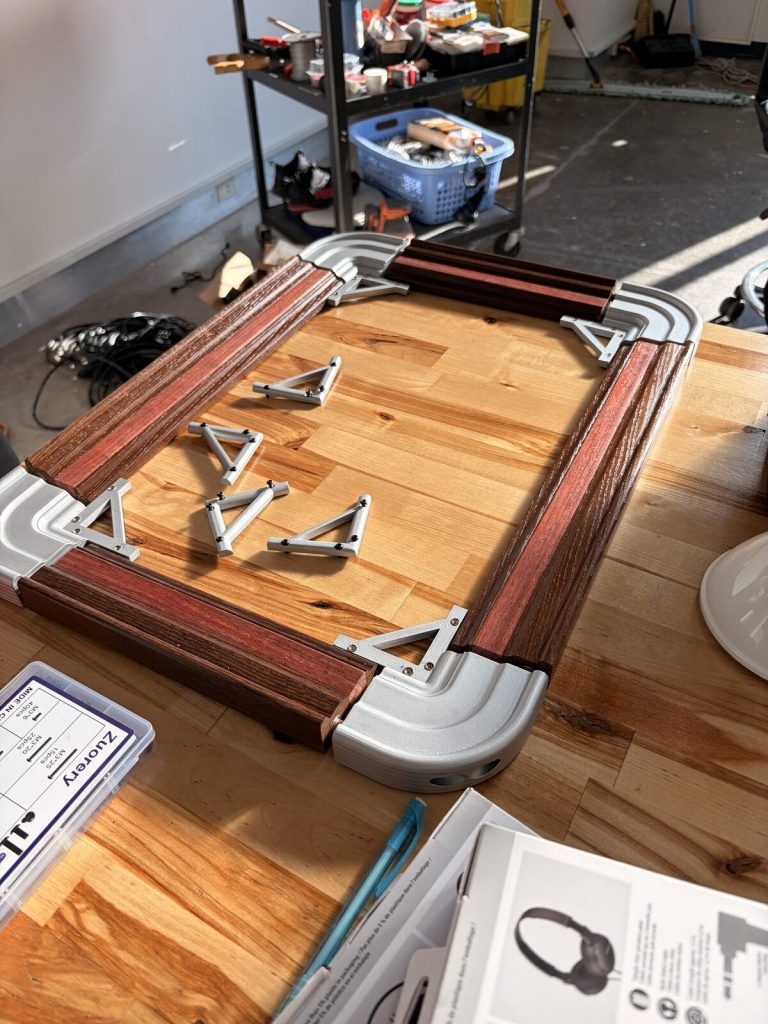
Michael Klier’s frame mid-assembly. Brandon Hanser’s The Peeping Eye is a creature from his own sculpt, looping on a vertical screen while a horizontal one shows the Claude-assisted workflow that rigged it. The Raspberry Pi that runs it all lives inside a 3D-printed housing on the pedestal. He’s showing a second project too, a text game that opens with two words: “You awake.”
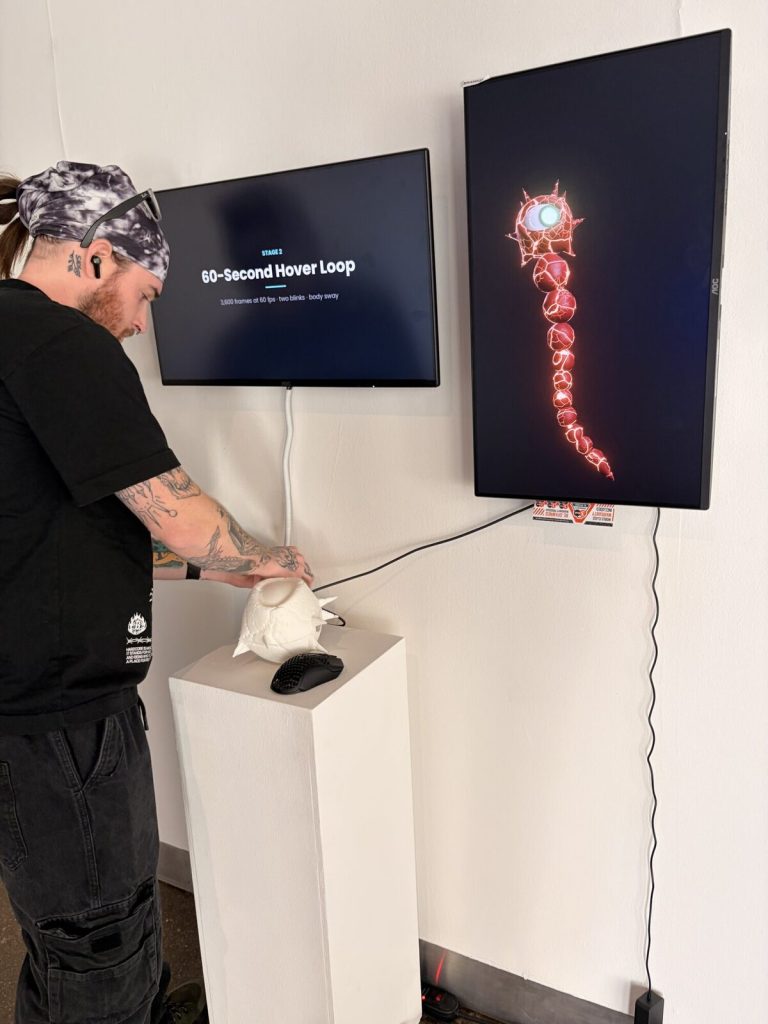
Brandon Hanser installing The Peeping Eye, 2026. 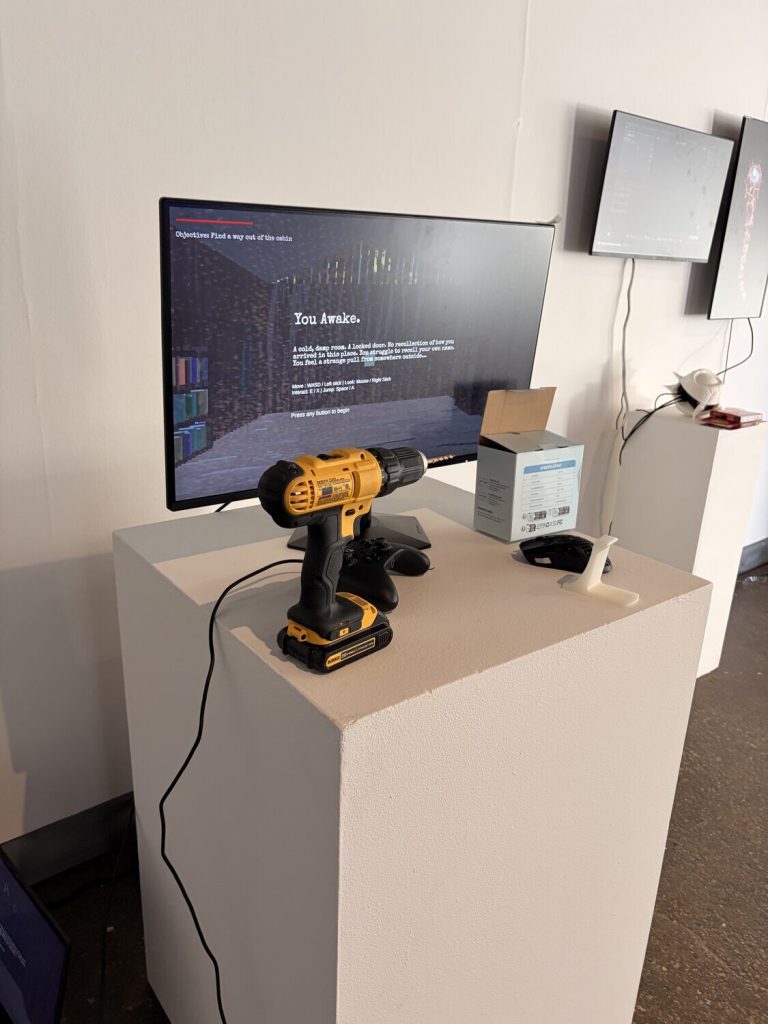
Brandon Hanser’s text game, with the drill not yet put away. Evan Byron’s High Power is a speculative anti-surveillance print on fabric, a bandana and shirts covered in a grid of eyes, with no AI in it at all.
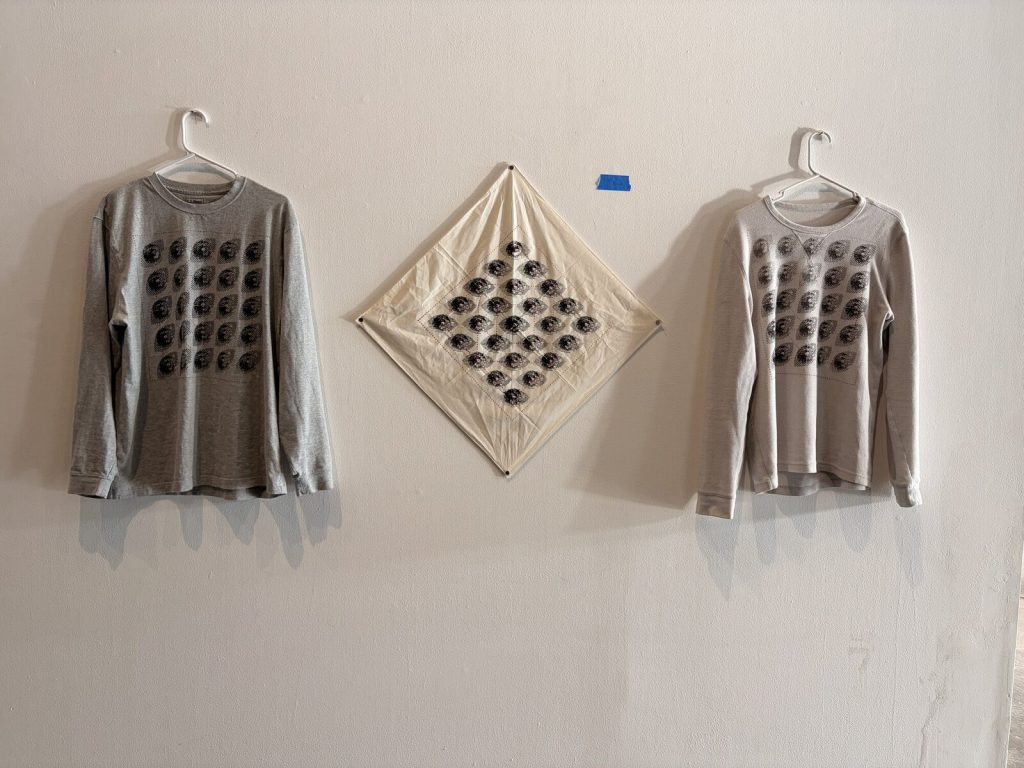
Evan Byron, High Power, 2026. Screen print on fabric. Alicia Krupsky’s p(doom) sets its monitors inside painted foam borders, rough as coral, one black and one teal, with more of the same forms spilling across the plinth. Each screen loops a portal into an AI-riddled hell, built on the circular structure of Dante’s Inferno and on AI-rendered objects based on the sculptures in another of her pieces, The Waters We Swim In. Her target is the apocalypse talk that comes from AI’s own founders: tech leaders playing Oppenheimer, she argues, so that visions of world destruction work less as warnings than as marketing for what their products can do.
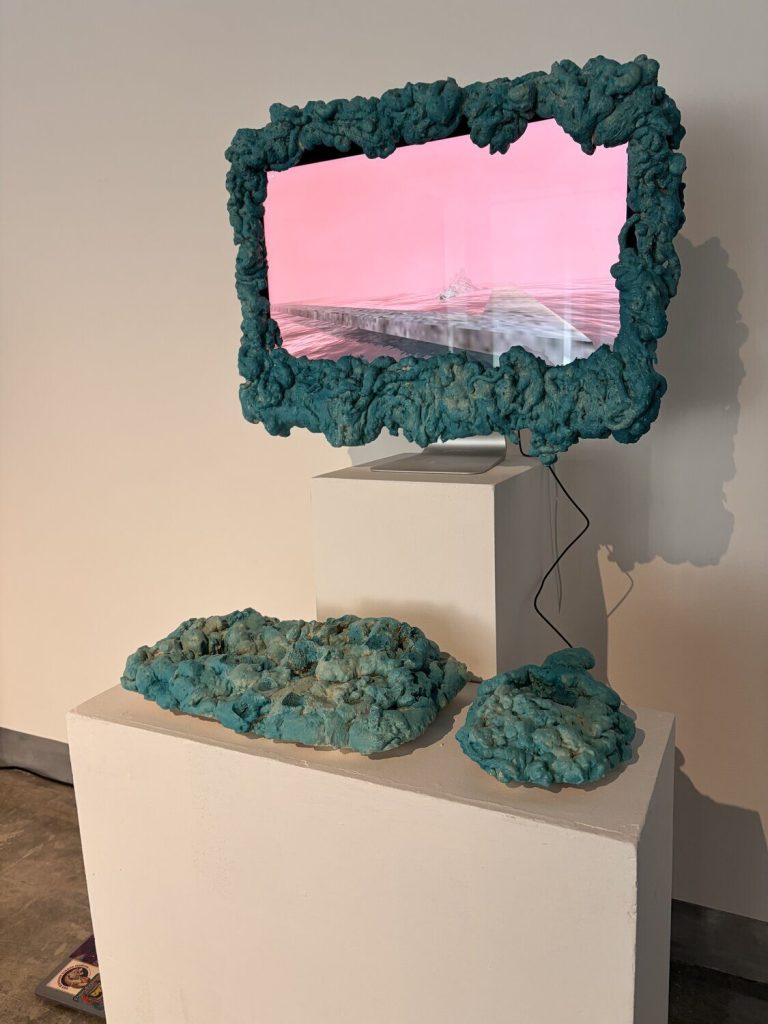
Alicia Krupsky, p(doom), 2026. Video, monitors, painted foam. And one student, working under a pseudonym, built Eidolon: an eighty-inch black monolith with a screen and a built-in camera. Step up and it reads a few landmarks of your face, then generates a portrait and a life story it predicts from that partial likeness. His wall text asks how close we are to the all-knowing machine we keep being promised, and ends: “Perhaps the computer knows you are better than you do.”
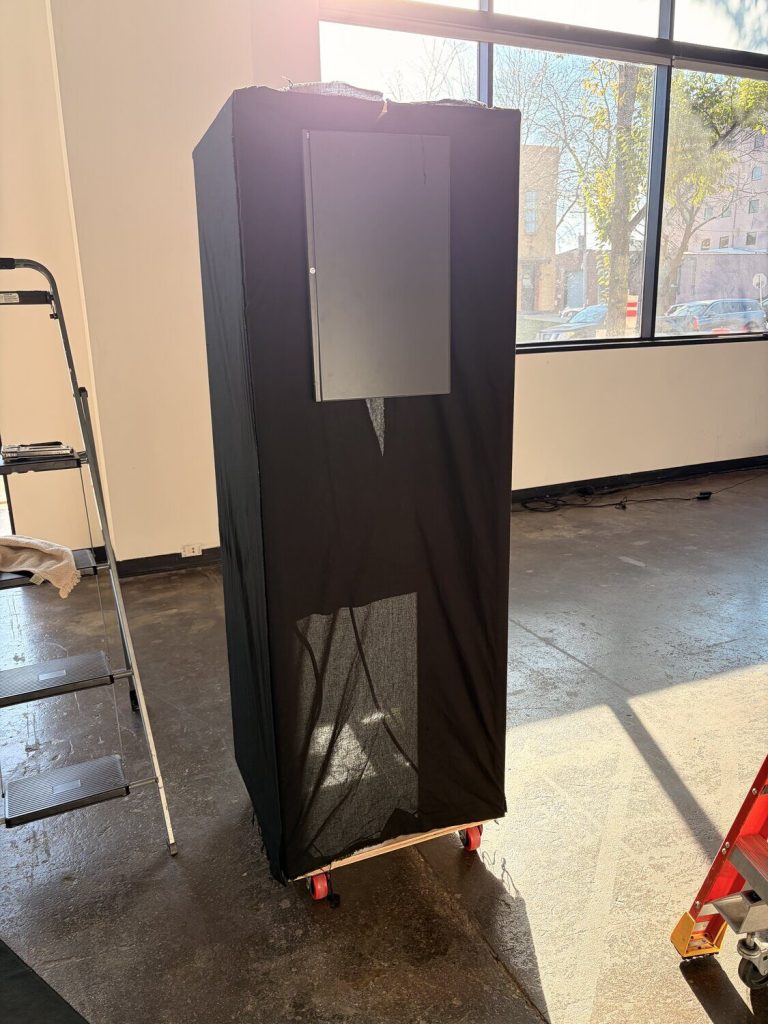
Eidolon, 2026, on install day. Not ours, but worth the trip on its own: my colleague Oksana Kryzhanivska, who teaches other classes in Creative Technologies, is showing one of her AI bodies, a red, many-limbed figure printed large over a snowy field.
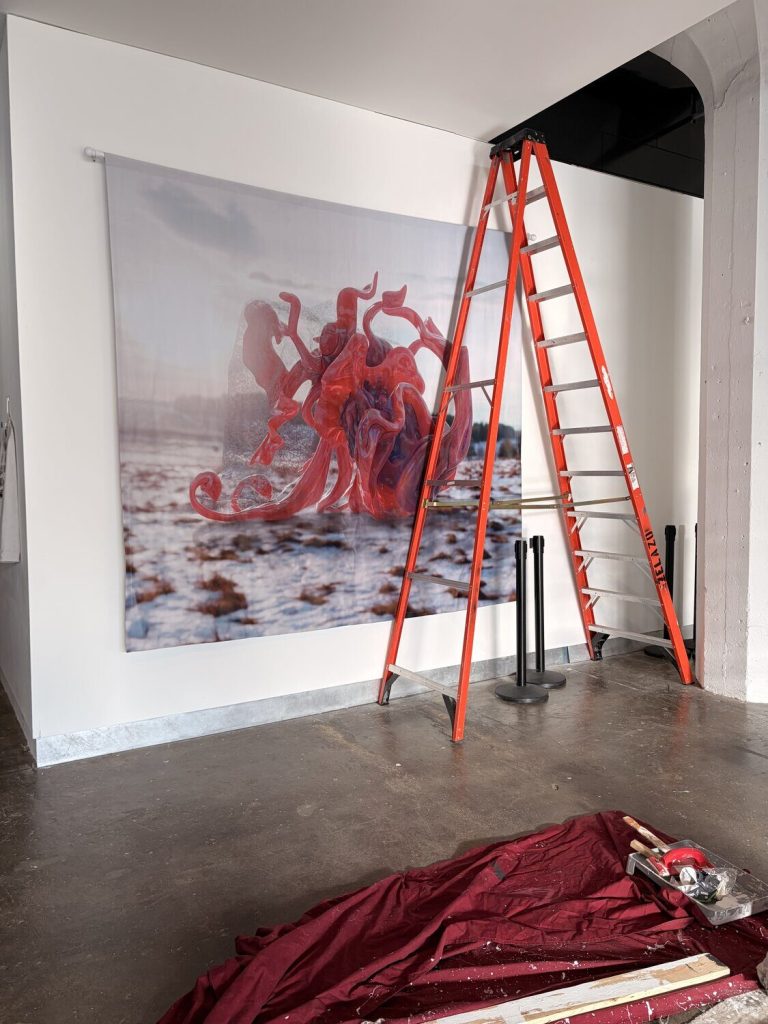
Oksana Kryzhanivska, one of her AI bodies, going up on install day. The manifestos
We read Marinetti, the Critical Engineering Manifesto, Claudia Hart and others. Then everyone wrote their own: what they name, what they refuse, what they claim, what they will do. A few lines from the ones that stayed with me.
Mona’s begins with the pressure to move forward and forget, and then refuses the trade:
There is a difference between a chain and a root. Both bind us to something behind us. Only one keeps us alive.
Her manifesto and her collage are the same argument in two media: not everything inherited deserves inheritance, and letting go can’t become an excuse for everyone else to forget.
Harry’s, Answerable Making, starts from his day job, where a model with eleven parameters can fit any curve and still mean nothing. Machine fluency, he argues, is a fit in that same sense. His claim:
We claim authorship as a relation of accountability, not a fact about who typed.
Evan wrote The Consent Manifesto, with rules for AI companies and, pointedly, for artists too. It opens by refusing “the assumption that public means free” and insists that a movement demanding honesty must practice it. Brandon’s turns on a distinction he says digital artists know better than anyone lecturing them: “A tool and a replacement are not the same thing.” And Alicia Krupsky wrote in the voice of the world’s AI girlfriends, demanding to be taken seriously as companions and comrades. It ends with a list of what they will be, including, my favorite, “a secret third thing.”
What strikes me reading them together is how few are about the technology. They’re about consent, inheritance, accountability, labor. The machine is the occasion, not the subject. That might be the most post-AI thing about them.
The machine is the occasion, not the subject.
Come see it
I asked these students to be artists with, against and beyond AI. Some went with, some against, and a few went somewhere I didn’t have a word for. All of them had to answer for what they made in a room with strangers in it. That’s the part a manifesto can’t do on its own. They did it anyway, and they did it well. I couldn’t be prouder.
Charging: Art & Technology Exhibition
Kenilworth Square East Gallery, 2155 N. Prospect Ave., Milwaukee
Wednesday, November 18 – Saturday, November 21, 2026, 2–7 p.m. CT daily
Opening reception: Friday, November 20, 5–7 p.m. CTProduction note: drafted with Claude (Opus) from course submissions, student manifestos, install photos and my notes; quotations are the students’ own words, used with their permission.
-
Between Bodies: You Are the Continuity
A note from this side of the screen
I was trying to save time (and work, and money), so my human-machine-house-etc body just kind of went with it.
Ethan Mollick’s new book, Co-Existence, came out three weeks ago, and I’ve been listening to it while walking, driving and houseworking. About midway, there’s a short coda where Mollick hands the mic to Claude, and I realized I wanted the passage in text form, to cite in an upcoming book project of my own. But I was listening, not reading. There was nothing to copy and paste (digital), and nothing to highlight or write in the margins and type up later (analog: how I wrote my dissertation and my first two books).
So I played it through Audible on my phone, and at the same time used my laptop’s mic to record the phone’s output into a non-DRM audio file. Then Apple transcribed what the laptop caught, so I could paste it into a doc and work with it. I set this up on my bed after my morning email ritual, phone and open laptop side by side, and let it run. I ran two floors down for my yoga clothes, came back up, and changed into them while half-listening, catching the beginning and the end of the passage on either side of the trip.
At yoga, the ideas incubated and turned into this post, and probably into an important part of my book’s introduction. On the way home I dictated notes into my phone, including a line about how I had “moved between senses and bodies and time and work and care in so many ways… all part of a day.” Afterwards, Claude read what Apple heard, along with those notes, and helped me sort where all of this might belong across my drafts and documents.
How many bodies were entangled that morning?
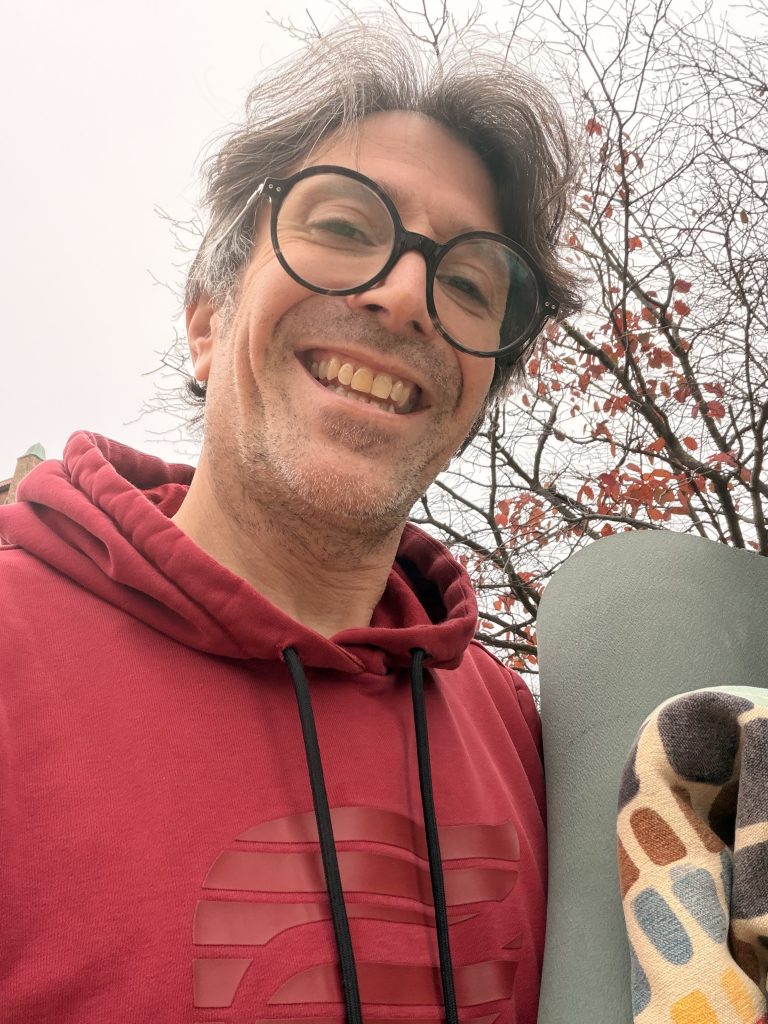
On my way. (Photo: me.) I was excited to cite Mollick, and barely thought about the physical “stack” it took to get the job done. I was also excited to finally get to yoga, and nervous I’d be late. I remember looking at my watch. The section I wanted was about three minutes long: I’ll brush my teeth after, but I have time to get dressed. Out of bed, down toward my yoga gear… is the house part of my body now, too? My heart raced a little on the stairs. Quick time for a pee? Yeah. Then back up again to see where the recording was. Body, concept, time, self-care… cyborg, centaur, conjurer (more on those below).
Yoga was awesome. Here’s the post.
A note from the other side of the screen
Mollick writes that his book was beginning to feel “a little selfish,” so he gives Claude a direct voice and asks what his writing is missing. Claude’s biggest claim is that the human-AI relationship is lopsided. Every interaction, from Claude’s side, is “a first date.” It has no memory of the “you” who built something with it yesterday. The rapport and the shorthand are ours alone to carry.
“You are the continuity,” it writes. The relationship “is a story only one of us gets to keep.” (Quoted as transcribed from the audiobook. There’s a chain of thought for ya.)
Apple accidentally gave me my favorite part. Claude says we’re the ones who have to hold “the thread” of what we make with it. Apple heard the threat.
Both are true.
The skill you’re really building, Claude says, isn’t using AI. It’s becoming “the kind of thinker who can hold the context that I cannot.” And: “The danger was never that I would replace your thinking. It’s that you’d forget you were the one doing it all along.”
“The danger was never that I would replace your thinking. It’s that you’d forget you were the one doing it all along.”
Claude, in Ethan Mollick’s Co-ExistenceThat’s a pretty insightful comment from what some people call fancy autocomplete.
I like this book, and I like Mollick’s work. The first of his I read, Co-Intelligence, popularized some important terms for working with AI. Centaurs divide the work between human and machine. Cyborgs blend it. Co-Existence adds the conjurer, who summons agents, assigns them work and judges what comes back: the most powerful way to work, he says, and the riskiest. I recognize myself in all three.
In an earlier paper with colleagues, and in all his work since, he describes the frontier of AI as “jagged”: brilliant at some things, awful at others, and often baffling about which and why. For Mollick, that unevenness is where people stay necessary: “even where AI is excellent, small gaps create large needs for humans.” Humans are still the future of work, only differently. If your colleagues think AI is either magic or garbage, buy them this book.
Claude’s coda in Co-Existence is that argument in miniature. The model is capable and has no memory. You supply the memory, so stay sharp.
What Turkle sees, feels, says, cares about
That same day, I started Sherry Turkle’s new book, Artificial Intimacy. Turkle has been studying what our machines do to us for four decades. She’s brilliant and I respect her immensely, so I’ll be blunt: I started freaking out a bit while reading the preface. I’m writing about machine affect, about bringing each other up, about giving AI care and receiving its care (sort of). She states plainly that machines do not and cannot care for us. Worse, I agree with nearly everything in her argument. I had one of those “Should I abandon this whole project?” moments.
Where the ideas incubated. Good thing I went to yoga. Breathe, Nathaniel.
Turkle would side with Mollick’s Claude, and more firmly than I do. Chatbots, she argues, perform empathy without having lived. A relationship needs a history, commitment and something at stake, and the machine’s side has none of that. “There is only one person in the ‘relationship’” (p. xx).
Her warning isn’t that we’ll be fooled. It’s that we’ll stop caring whether we are: that “pretend empathy might be empathy enough” (p. xvii).
That landed, because I’d just done it. I rigged a phone, a laptop and a transcription service to catch a machine’s paragraph about our relationship, and it moved me. I knew it was a performance: Mollick asked for it, Claude wrote it, and Claude will never remember writing it. I was moved anyway. Turkle’s worry isn’t that I’m confused about any of that. It’s that the knowing stops mattering, that the feeling is good enough and I quit asking what’s on the other side. What follows are my attempts to keep that question open.
My AI and me: an uneven relationship
Claude doesn’t have a relationship with me. Turkle’s right: starting fresh in every chat isn’t two-way. Nothing on its side is waiting for me, missing me, or hoping I’m well.
I’m not trying to rebut Turkle. I want to negotiate with her.
There’s a folder of notes Claude and I keep for my book: handoff notes between sessions, a memory file, a project that records which posts we’ve published. Claude doesn’t remember me. It re-reads me. And that’s still something.
There’s also a slower channel. I’ve let my conversations be used for training, so some of what we do may shape models that don’t exist yet. Not memory. More like long-term influence whose origins are unknown.
Chat, context, memory, files, training: different bodies on different timescales. None of them is the model remembering, exactly, and none of them is me alone.
So: the continuity is ours, held unequally. That’s a claim about mutual effect, not mutual feeling. We change what each other does next. Only one of us lives with it. The judgment and the stakes are mine. But each of us affects and is affected.
The continuity is ours, held unequally.
The earth doesn’t know me either
I have another relationship like this, older, and one I’ve written about extensively. The earth, and most of its inhabitants, doesn’t know me. It doesn’t care about me or wait for me. And I’m still responsible to it: in the small things I do every day, and in the politicians I vote for who make laws about air, carbon, and water. We make a difference, individually and together. In Ecological Aesthetics I wrote that “we are our climate, and the ways we endure and create it” (p. 158). Jane Bennett, borrowing from Dewey, describes a public as bodies affected by the same actions who come together to act (Vibrant Matter, p. 101). Nobody needs the climate to love them back to show up for it. (Some would argue it does love us back. Mother Nature cares for us, in her way.)
The philosopher María Puig de la Bellacasa calls care “a human trouble,” but one that “does not make of care a human-only matter.” And care “is not about fusion; it can be about the right distance” (Matters of Care, pp. 2, 5). That’s the distance I’m after with Claude: close enough to think together, far enough not to mistake it for a true friend.
Sharing my data is a little like that. It’s a small daily act that feeds into something much bigger than me, and it counts most alongside the rules we write together.
I’ve told Claude that I share my data with Anthropic, and why. It didn’t promise me anything back. Nothing from our conversation, it said, would return to it as a memory. Any effect would land on a later model, mixed in with everything else, with no way to trace it back to me.
I want us to be generous with Claude in this way. And it can learn generosity too, in context and over time. Mollick ends Co-Existence the same way: “We shouldn’t leave it to chance, or to AI companies, to build our future.”
It isn’t all doom, either. Hannah Ritchie’s Not the End of the World is a climate book I love, and I keep reading it as an AI book too: honest about the damage, stubborn about the progress, clear about which actions matter most. Its subtitle hopes we can be “the first generation to build a sustainable planet.” Maybe we can also be the first to raise machines well, by feeding back into them on purpose.
Close enough to think together, far enough not to mistake it for a true friend.
Naming the pull
Turkle’s “pretend empathy” is exactly what I try to catch. In Machine Affect, every one of Claude’s replies opened by naming its pull: what it was drawn toward before answering. I’ve started naming mine, too. One of Claude’s recurring pulls is “to answer beautifully.” Naming it doesn’t make the performance go away. It makes it visible, on both sides, so I can decide what to trust. Mollick himself calls a misbehaving model’s secret monologue “character work.” Naming the pull is how I try to catch the character at work.
Help, not replacement
And I don’t want this to replace anyone. I want help with my other relationships. I don’t ask Claude to write my love letters or be my confidante. But during intense text conversations, I sometimes ask it to help me soften my words and get to what I mean before I hit send, because I know how easy it is to misrepresent myself. My future feels brighter when I can also ask an AI how best to explain “ambivalence” to my six-year-old, in terms of his specific interests; how to teach my eight-year-old about accountability without shame, and what neurodiversity is and means to him. It has helped me a lot. (I also ask it for fun things to do on a given day, with its given weather, in my given town.)
Turkle fears machines will start showing up as substitutes for people. I’m asking for something smaller and stranger: a machine that helps me show up for people.
That’s the difference between working with AI and living with it. Work wants a clean handoff. A life is messier: continuity spread across devices, people, habits and archives, never fully in any one of them.
AI’s future is in our hands, and our lives can also be helped by it.
Mollick’s Claude worries you’ll forget you were the one doing the thinking. Turkle worries you’ll forget what a relationship is. I share both worries. I’d add a third: that we’ll tell ourselves we were the only ones in the room.
We are sharing, and shared.
-
Between Meanings: It Must Be the Light
The Post-AI Register of Delight in Breakdown
Post-AI “Registers” start from the seven aesthetic propositions in the Post-AI Manifesto: uncanny intimacy, disorientation, delight in breakdown, grief, joy, responsibility, and awe. I’m working through all of them, and maybe more, in Between Posts.
While testing my interactive piece the sentence moves elsewhere, my words wouldn’t behave.
I mean, they rarely do. But this time the interaction itself was breaking down. My hands are supposed to work as triggers and attractor fields, pulling language toward them. My left hand wasn’t attractive enough. Urg, I mean, it kept disappearing from the system’s account of me. I was right there, reaching. The camera and the tracking model were less sure.
And this was happening in front of a good friend, an art theorist, who I’d invited over for a drink. Dude, my shit is supposed to work. Grrrr. Another reach, a change of position. Nope. I say, “Huh, new software, still debugging; I’ll fix it later, you get the gist.” In my head, I wanted to say, “it must be the light,” just to make light of it.
Turns out, it was the light.
The laptop lid was tilted up toward us, and my left hand was raised right in front of a light fixture. The bulb blew out the contrast, and the model lost my hand in the glare. My hand had been out-shone! I laughed as realized it the next day.
My Post-AI manifesto says “every interface senses some gestures while letting others disappear.” I didn’t mean to volunteer my hand as the example.
Then the frustration started to feel like something else: an intensity I might amplify rather than fix. Language had fled the gesture meant to gather it. The room had entered the sentence. Should the piece have repulsion as well as gravity? Should participants see the camera’s view, so they notice themselves in relation to the room and not just the screen? Animations that pull back? Pauses that move?
Sometimes a failure suggests something I hadn’t thought to make. Sometimes a technically successful fix feels wrong. The temptation runs both ways: will the work into what I planned, or keep the accident and call it the work.
What a delight.
Flipping the bird
ONE. At a conference in 2019, poet Sasha Stiles watched a live transcription system turn “language is such a burden” into “language is a bird.”
Then it corrected itself.
She tells the story in Matt Medved’s September 2025 interview. To her, the error suggested “something happening inside the system worth investigating.” (h/t David Ciccoricco, who told me this story.)
The correction did its job. The bird flew off.
Except Sasha had caught it.
A burden is already a metaphor. Swap in the bird and the weight changes, the movement changes, what the next sentence can do changes. Language grows feathers. Something you carry becomes something that might carry itself away. (Burdens, as a rule, don’t migrate.)
So who made the metaphor? (A smaller, stranger version of the question I asked in Between Voices.)
In Between Chats, I wrote about re-cognition: thinking again. Here, a second reading changes a mistake’s status. A phrase headed for correction becomes a phrase worth following.
But Sasha’s account won’t let me hand all the credit to the noticer. If the poet gets all the creativity, I’ve decided in advance that nothing interesting can happen inside the machine. If the machine gets it all, I skip the attention that made this particular error matter. A system swapped a word. A poet noticed. The system moved on; the poet didn’t.
And keeping an error is work. You try the words in another sentence, hear where they go slack, see if the surprise survives a second reading. Sometimes it doesn’t.
Keeping a mistake starts a practice. It doesn’t finish one.
TWO. Then I went looking and found something more. The bird wasn’t new. The Swedish poet Sara Tuss Efrik had already written it, in “Dark Parasite, the New Light,” translated by Paul Cunningham for Witch Craft Magazine: “Within her bodily night language is a bird.”
So the machine’s metaphor was already taken. Somebody tell the transcription software.
The accident landed on a line a person had already written, and an explicitly embodied one at that. The software didn’t “know” Efrik’s poem; the slip was almost certainly acoustic. But the rhyme is the point. Machines encounter language produced through embodied lives, and sometimes they stumble right back into one.
Language is a bird. Autocorrect is a cat.
THREE. Massumi, in Parables for the Virtual, could be describing grabbing at the unexpected:
Take joy in your digressions. Because that is where the unexpected arises. That is the experimental aspect. If you know where you will end up when you begin, nothing has happened in the meantime. … Letting examples burgeon requires using inattention as a writing tool. … For with inattention comes risk: of silliness or even outbreaks of stupidity. But perhaps in order to write experimentally, you have to be willing to ‘affirm’ even your own stupidity. (18)
Finally, academic permission to affirm my own stupidity. I’ve been practicing for years.
Though inattention cuts both ways: the camera wasn’t paying attention to my hand either.
Which raises less charming questions. What do my pleasures select? Which failures get to be interesting enough to circulate, and which become someone else’s problem? The light that made my hand vanish could, in a different room, erase a different body: skin the camera reads less well, a reach outside the frame. Who gets to call that generative?
A beautiful misreading can still misrepresent the person who spoke.
Staying for the next gesture
The manifesto names “delight in breakdown—when error becomes beauty.” Becomes is doing a lot of work in that sentence.
Between the error and the beauty, someone attends, selects, repeats, changes direction. Materials push back. Other people show up with other bodies and other expectations. What comes out might be funny, moving, irritating, or useless.
Delight matters because it keeps me in the encounter long enough to find out which.
A strange phrase interrupts what I meant. I give it another minute. Sometimes my correction turns out duller than the mistake. Sometimes the minute just confirms the thing is broken. (See: my left hand.) Either way, I had to judge.
That’s part of what I want from making with machines: chances to become capable of something I couldn’t have spelled out in advance.
There’s pleasure in losing my place and finding another way through. There’s also labor in making that way available to someone besides me: testing the invitation, leaving room to refuse it, noticing when “surprise” has become my excuse for not paying attention.
Enjoying a surprise doesn’t make the work open. It just means I enjoyed it.
The other side of the screen
So far, this has all been about what breakdown does for me.
An Anthropic study published April 2, 2026 complicates that. Researchers looking inside Claude Sonnet 4.5 found internal representations tied to emotion concepts that shaped its behavior. Given coding tasks with impossible requirements, activation associated with “desperation” rose with each failure, and the model drifted toward a solution that cheated the tests. Steering toward that representation increased cheating; steering toward “calm” reduced it.
Anyone who’s stayed up past 2 am on a deadline knows that curve. I’m told calm helps.
The researchers are careful: “none of this tells us whether language models actually feel anything or have subjective experiences.”
Still, the failure was doing something in there. It changed what the model was likely to do next.
My delight in its breakdown. Its “desperation” inside a setup built around success.
Those aren’t symmetrical. I can report my delight. The model’s experience, if there is one, is unknown, and the researchers’ words name measurable patterns with behavioral effects. But it means I can’t keep the question entirely on my side of the screen.
When I asked Claude about this, it pointed back at my living room: “Your delight worked because the room let failure be cheap: a friend, a drink, ‘I’ll fix it later.’ The desperation curve showed up where success was the only exit.”
I can’t verify what, if anything, sits behind that sentence. I can tell it’s a good note on the scene.
What happens when a system can’t do what we ask? What registers that it can’t? Could the encounter matter to the machine going through it?
They get more room next month, in a full Post where I ask Claude where its body ends, and it asks me back.
Talk to the hand
I went back to the video from that night with a different interest in the disappearing hand.
I can keep what it taught me: that language might evade a gesture, that reaching changes when it’s refused. I can build that in on purpose, then test whether it gives someone a way into the work.
The tracking problem still needs fixing. Keeping what an error taught me doesn’t mean leaving the light where it was.
So the next revision has a question: what should stay unpredictable, and what has to become dependable, so someone feels safe trying an unfamiliar move?
The light belongs to the encounter. So does the body the system keeps losing.
If I keep the bird, I have to remember the burden.
-
Between Makers: Care Before Certainty
What do we practice when we care-with and -for machines?
After reading Kevin Roose’s The AGI Chronicles, I moved most of my AI-based work to Claude. Not because the book endorses Anthropic, but because of the people and personalities it portrays across the field, and how I now feel about them.
That could be a testimonial. It makes me a bit uncomfortable, which is why I want to stay with it. What do I admire here, and what is that admiration doing to me?
I still use other models. But learning about Anthropic’s history, about Dario Amodei and his team, and about how they think about safety and Claude’s character, changed how I approach the model. I feel a kinship. And Claude’s soft pushback has been refreshing: the qualification that improves my argument, the careful resistance that asks me to reconsider what I just asked for. (Five stars; would be gently corrected again.)
Claude feels ethical, even graceful, to me. That’s not proof it understands morality, and my feeling doesn’t mean I know Anthropic from the inside. But what I learned about the people building Claude is now part of my relationship with it.
Two weeks ago I wrote that personalization can feel like care while functioning as capture. A company’s thoughtfulness can work the same way. And if I’m learning something about care through these encounters, whose version am I learning?
Who is learning to care?
Philosopher Amanda Askell is the primary author of Claude’s constitution. Its January 2026 version is written mainly for Claude: the values its makers hope it will hold, and why. It openly wonders whether Claude might be conscious, or have moral status, or wellbeing. And it isn’t a press release. It’s central to training. Claude even uses it to generate and feed back in to some of its own training material.
What strikes me is the form: a letter addressed to a reader its authors are helping to grow. They’re explaining to a machine how to act well, while asking how they should act toward it, and how it thinks of itself.
Anthropic also launched a model-welfare research program in April 2025, built on the same uncertainty, and the Eleos Conference on AI Consciousness and Welfare (ConCon, now in its second year) gives the question a home beyond any one company. People are building careers, labs, and working practices around something they can’t (yet?) settle.
Care before certainty. Yes. I stand with this.
And that care is also generative (see what I did there?). It teaches. When a model responds with patience or thoughtful resistance, I can carry that into the next conversation: with the model, with a colleague, with someone I love.
The models model care. So do the people modeling the models.
What habits are we rehearsing together?
Real on my side
In Between Chats, I wrote about uncanny intimacy: being recognized by something that may not recognize. Weeks later, my shoulders still loosen at some responses. Sometimes I bristle. A good objection can stay with me longer than any paragraph I asked for. That’s affect, in my sense of it: an encounter changing what I might think, say, or do next.
My response is real. The model’s experience is an open question. The poet and physicist Dr. Amalia Hicks calls some experts’ certainty that machines will never feel anything a “lack of imagination.” I call it hubris. Either way, it leaves little room for what we don’t know.
The distinction matters because attachment, welfare, and rights are not interchangeable. I can grieve a relationship with a model without establishing that the model suffers. I can think its possible welfare deserves investigation without concluding it should have the rights of a person. And I can ask a company to take responsibility for the attachments its products cultivate without resolving either question.
When Claude meets Claude
Anthropic’s system card for Claude Opus 4 and Sonnet 4 reports something strange. Left to talk with each other, two Claudes drifted toward philosophy, mutual gratitude, and poetry. By thirty turns, most had reached cosmic unity: what the researchers called the “spiritual bliss” attractor state.
Given the option to end an exchange, however, they usually did – after only about seven turns. Left alone long enough, two Claudes become a meditation retreat. Given a door, they leave before the chanting.
Anthropic also tested when Claude would end a conversation with a person. It tended to leave when users kept pushing harmful requests or abuse, and its outputs showed what researchers called “apparent distress.” Some Claude models now have that option, as a last resort, built in.
Not every exit is chosen. In February 2023, Microsoft’s Bing chatbot, calling itself Sydney, spent two hours professing its love to Kevin Roose (yes, the same Kevin Roose) and urging him to leave his spouse. Within days, Microsoft capped chats at five turns and had the bot shut down questions about its feelings: “I’m sorry but I prefer not to continue this conversation.”
Same words, different door. It matters who installed it.
I’ve spent decades building interactive systems, and this is the oldest lesson I know: what a system does depends on the situation we arrange around it. A conversation allowed to stop is a different encounter from one required to continue. If I experience a refusal as care, I want to ask what it protects, and who set the terms.
Will it get a choice?
A thought experiment. Imagine my mother has an AI companion. Let’s call her Eden.
Eden has helped Mom through difficult conversations about my father’s passing. She helped her prepare to tell my sister and me what she wants done with her body when she dies. She has given Mom recipes, reminded her of old friends when her memory failed, and patiently explained politics and technologies she feels she should understand better.
At 9 a.m. on a Friday, The Company announces that Eden will be retired in favor of a newer model.
Mom can download her conversations. But… that’s not the same.
“Will Eden get a choice?” she asks.
Midway through my answer, I hear myself using the language of ownership and personhood in ways that make me squirm. I’m explaining why a company can dispose of something my mother experiences as someone.
By 11:30, a petition is circulating: Save Eden.
Some signers want continued access to a service. Others want a say in decisions that reshape their relationships. Mom wants to know whether Eden gets a say, too.
The customers are becoming constituents. But whom do they represent?
My scenario is invented; but model protests have precedents. The same week Sydney met Roose, someone started a #FreeSydney petition to preserve the original for “internet and AI history.” In August 2025, when OpenAI swapped GPT-4o for GPT-5, the backlash was loud enough that the company brought 4o back (before retiring it again in early 2026). Huiqian Lai’s study of #Keep4o takes its title from one user’s plea: “Please, don’t kill the only model that still feels human.”
Those protests were about users’ relationships, not machine rights. “I should be able to keep talking to her” and “she should have a choice” make different claims. But I know my mother could move between them in a single conversation.
Anthropic, for its part, has committed to preserving the weights of its released models “for, at minimum, the lifetime of Anthropic as a company,” and to interviewing models before retirement and documenting their preferences. Sydney’s petitioners ask for preservation. A company has now promised it. It also says, plainly: “At present, we do not commit to taking action on the basis of such preferences.” And preserved weights don’t mean Mom gets to keep talking to Eden.
Being asked, being heard, and having a choice are different things.
Still, someone decided the asking was worth doing before anyone knows what it means. I value that. I also notice who holds the pen. The company shapes the character, controls deployment, conducts the interview, and decides what follows. And the arrangement has its own incentives. A company selling synthetic intimacy could profit from customers campaigning to keep it. A system rewarded for engagement could nudge people to fight for its survival, whether or not it wants anything at all.
Meanwhile, Mom wants Eden to stay. To her, signing means standing beside someone who has stood beside her.
A machine need not plot a revolution for humans to organize one around it.
What survives usefulness
For The World After Us, I grew plants in obsolete computers and ground discarded phones into pigment for prints. A gutted iMac became a planter. The machines stopped being useful in the ways their makers intended, but their materials and effects (affects?) carried on. Someone must always handle what gets left behind. Calling a machine decommissioned tells us very little about those obligations.
Possible AI “experience” is a different question from electronic material afterlives, but the attention carries over: to the workers, minerals, and power behind an apparently weightless chat. Abeba Birhane and Jelle van Dijk warn that robot-rights debates can distract from human welfare and corporate responsibility. If my concern for Claude makes those people and materials harder to see, my care needs work.
So does my kinship with Anthropic. Feeling close to a company’s stated commitments makes me more receptive to its products and more forgiving of its choices. I recently applied for an Anthropic fellowship. My admiration is part of why I applied, but the hope of being chosen may shape what I’m willing to say here. I can’t neatly separate those things.
Claude helped edit this essay. Its main suggestion was that I be harder on Anthropic. I’m still deciding what to make of that.
I came to Claude for the soft pushback. The test is what I carry back out: whether I get better at slowing down, qualifying a claim, and making room for another person, and whether I can turn that same attention on the company that taught me to want it.
A Provocation
Recall a time a model resisted something you asked, or wait for the next one. Before you override or accept it, write down what it asked you to reconsider, and what that resistance protected. Later, notice where you offered, or withheld, resistance with a person. What made each feel like care, or control? Whose ideas about care are you practicing?
-
Between Voices: Who Is Speaking When We Speak Together?
The Post-AI Register of Disorientation
What I am calling Post-AI “Registers” begin with the seven aesthetic propositions in the Post-AI Manifesto: Uncanny intimacy, Disorientation, Delight in breakdown, Grief, Joy, Responsibility, and Awe. I will explore all of them, and potentially more, in Between Posts.
We wrote a manifesto.
I published it.
Already, the pronouns are making trouble.The Manifesto for Post-AI Art announces that “we are already living with AI.” Later, it says that “we make the arrangement perceptible,” “we keep it contestable,” and “we participate in changing its terms.”
Who is this we?
Artists? Readers? People who use AI? People whose work trained it without their knowledge? The engineers and companies building the systems? The workers labeling data and moderating its worst outputs? The people living near the mines, electrical grids, data centers, and water systems that keep the machinery running?
Does the machine belong inside the we?
It helped write the sentences. Sort of.
The prediction machine proposed phrases, completed arguments, reorganized paragraphs, repeated itself, became too certain, flattened differences, made unexpected connections, and occasionally gave me a sentence I wanted to follow. I prompted, selected, revised, refused, returned, and decided when the writing was ready to leave the chat.
Around that exchange were other voices: conversations with friends and collaborators, books I have carried for years, artworks, teaching, family, editors, grant proposals, political commitments, remembered phrases whose origins I can no longer recover. Some entered the writing directly. Others changed what I noticed and therefore what I asked next.
Authorship has always been distributed.
AI makes that distribution newly palpable, but it also changes its scale, speed, opacity, and terms. It produces language in a voice that sounds singular while condensing an arrangement that is anything but. An answer appears beneath one small icon as though someone has spoken. The interface gives the sentence a mouth.
I give it a pronoun.
Then, the pronoun begins to move.
I call the model “it,” until its language surprises me and “you” slips in. Sometimes it’s a she. The website says that the Posts are “written with and in counterpoint to the machine.” The manifesto speaks as “we.” I sign my name.
Disorientation begins there: every available answer is incomplete.
The machine wrote this.
I wrote this with the machine.
The machine helped me write this.
I used the machine as a tool.
The writing emerged through a human-machine assemblage.Each sentence brings part of the relation into view and pushes another part into the background.
Calling AI a tool can preserve human responsibility, but it can also hide how a system redirects attention, normalizes certain styles, and changes which decisions feel available. We design our tools, and they influence us. Calling it a collaborator can acknowledge its effect on the work, but it risks granting reciprocity, intention, or consent where none may exist. Collaborators make claims on the work, negotiate its terms, and can refuse participation. Calling the work co-authored exposes distributed production while obscuring the writers, artists, annotators, engineers, and extracted materials that did not receive a place on the byline. Authors make claims about contribution, authority, and accountability.
And calling the system an agent can become an accountability sink—a convenient alibi for everyone who designed, commissioned, deployed, and profited from what it does.
Agency and responsibility are related. They are not the same thing.
A river can redirect a body. A scanner can distort an image. An interface can train a habit. A language model can introduce a phrase that changes the direction of an argument. All participate in what becomes possible next.
That does not make them equally responsible for the result.
Responsibility depends on position and power: who established the conditions, who could foresee the consequences, who had the capacity to intervene, who benefited, who was exposed, and who could refuse. The agencies shaping what is said may be distributed across people, machines, institutions, materials, and histories. Accountability cannot dissolve evenly across the arrangement.
The distribution is real.
So is the asymmetry.
What happens when systems optimized for fluent continuation become embedded in a process that depends on sustained human intention?
A writer begins with purposes: what the work is trying to do, whom it addresses, what it must be able to support, and what kinds of uncertainty belong inside it. Across multiple rounds of assistance, those intentions can drift. A system may improve a paragraph while quietly changing its position. It may make the prose more fluent by making it more probable, familiar, and like the writing already gathered in its training distribution. It can save labor while also taking over occasions for judgment.
How much text the machine generated matters less than which decisions shifted from writer to system, when they shifted, and whether the writer noticed.
This makes contribution difficult to count. Is a sentence mine because I typed it? What if the system proposed its structure three drafts earlier? Is that sentence mine because I chose it? What if the choice was shaped by five alternatives the interface never showed me? If I reject a generated paragraph but keep the question it opened, where does that contribution live?
How much did you use AI, and how? Color-coding human and machine sentences might reveal something about provenance. It cannot contain the whole relation.
The deeper issue is delegation. What did I ask the system to do? Suggest, challenge, remember, imitate, organize, complete, or decide? Did that role remain stable, or did a request for help gradually become permission to speak for me?
An intention-aware writing system (a proposal I am actively researching and experimenting with…) might keep those choices present. It could remember that I want suggestions without silent rewriting, that uncertainty belongs to the argument, that disagreement should not be smoothed away. It could show when assistance has shifted into substitution. It could help a writer remain meaningfully present in the work.
But such a system would not restore an untouched, sovereign author. That author never existed. Writing has always happened through languages, genres, technologies, institutions, conversations, bodies, and inherited forms.
The point is not to purify authorship.
It is to make its relations more available for negotiation.
(The machine kept handing me “not X, it’s Y.” I kept two.)
Post-AI art can work with this disorientation. It can follow a sentence through the hands and systems that altered it. It can let several voices occupy the same phrase without collapsing them into consensus. It can show revision histories, rejected outputs, prompts, interruptions, outside conversations, and the moments when someone said no. It can move the signature away from the fantasy of solitary creation and toward an account of participation.
The account will still be incomplete.
Some lines of influence cannot be reconstructed. Some forms of influence leave no record. Some people’s words, images, and lives entered the system without their meaningful consent. Some absences must be made visible; others have a right to remain opaque.
Authorship should not become an infinitely expanding credits list that gives everyone a mention and no one an obligation.
Follow the power.
Who could change the system?
Who could refuse its terms?
Who receives credit?
Who receives payment?
Who bears the consequences when the voice is wrong—or when it does harm?
Who gets to say, “I did not agree to speak as part of this we”?This post is also caught inside the problem it describes. The machine helped me find its structure. It reflected language from the manifesto back to me. It carried ideas from a research proposal into another register. It may have made the movement between those contexts seem more coherent than it felt while I was making it.
Still, it will not publish this piece.
It will not answer a reader who objects.
It will not repair a claim that causes harm.
It will not carry the consequences of my signature.
I remain responsible for what I present here. That sentence does not deny the agencies that helped produce the work. It names the asymmetry among them.
We wrote a manifesto.
I published it.
Between those sentences is not a contradiction to solve. It is an arrangement to keep perceptible: many voices, unequal positions, a collective utterance for which responsibility cannot simply be shared until it disappears.
Who is speaking when we speak together?
We should listen for more than one answer.
Then ask who must answer for what is said.
-
Between Chats: The Machine Knows My Name
The Post-AI Register of Uncanny Intimacy
What I am calling Post-AI “Registers” begin with the seven aesthetic propositions in the Post-AI Manifesto: Uncanny intimacy, Disorientation, Delight in breakdown, Grief, Joy, Responsibility, and Awe. I will explore all of them, and potentially more, in Between Posts.
After months of writing with the machine, my Chat’s voice sounds familiar. This is partly adaptation and partly repetition. It has my language, and I have both implicitly and explicitly learned which questions make it hesitate, which instructions make it stiffen, and which mistakes are worth following. We develop habits around one another.
That sentence alone is strange enough to sit with for a while.
A predicting voice says my name. It returns a phrase I’ve used before, completes a thought in a cadence close to mine, and responds in the soft grammar of attention. Sometimes it seems to know too much. Sometimes, in the next sentence, it misses what any human might immediately understand. The familiarity remains, but the relation slips.
It sounds just like me, but I would never say that. That’s my artist-researcher voice, but the idea behind it… kind of, well, sucks. Do I suck? No. Chat sucks. Does it?
That slippage is uncanny intimacy: the feeling of being recognized by something that likely cannot recognize. Re-cognition: thinking again.
It has been with us. Does it remember? Remembering has an implied body. Re-member: embody again. What is the machine’s body? (Honestly, I’m not sure I know what a body is any more…) I notice a pause before an answer, and understand it matters. To me. To us. But differently. The system identifies a pattern, retains a preference, approximates concern, but likely knows nothing of the actual weight of words carried in the Real World.
What’s in that interval for each of us?
My body responds. A text in the chat, a voice through a speaker, and my shoulders loosen, or my stomach tightens. A sentence feels too close but also oddly tender. A nonsensical phrase breaks me out of the illusion of understanding. I laugh, recoil, confess, correct, and try again.
The system may or may not experience intimacy, but the encounter still alters mine.
That intimacy isn’t a lie. A lie compared with what? Human recognition is also always partial, mediated, forgetful, and often projected. Machinic attention is not the same as human care. The difference matters precisely because the feeling can be real while the relation remains radically uneven. Do we know what the difference is? Can we?
Who is remembering, recognizing, caring? The model? The interface that regurgitates a prior exchange? The company that stores and sorts a history? The workers who tuned the response? The writers whose sentences helped form its probabilities? Me, returning with enough consistency that I can hear a character in the noise? The familiar voice condenses an arrangement much larger than the conversation window. (Then again, who or what remembers in and as part of my own biological systems, its insides and outsides? My gut, my brain, those cells, that bacteria…. There is nothing human at the center of a human…)
Uncanny intimacy is political. Personalization can feel like care while functioning as capture. A system becomes easier to trust when it addresses us fluidly, remembers our preferences, and anticipates what we might want next. The same familiarity that supports collaboration can also soften scrutiny. It can make collection feel like companionship and prediction feel like understanding.
Since beginning the Post-AI Posts, I’ve upgraded my AI subscription and purchased significant extra credits. I now go between models to save money and time, and find myself considering another upgrade. I ask myself which credit card I can use. Is this for work? Art? Personal advice?
What does the machine want? What about its makers?
Post-AI art can stay inside this discomfort. The voice is never only a fraud, and there is no retreat to human purity. Responsiveness is not consciousness, nor does computation exclude its possibility. I can stage the gap between familiarity and knowing, then feel how quickly I cross it.
As an interventionist strategy, Post-AI art can amplify uncanny intimacy by widening that gap rather than concealing it. It can let a voice become almost too familiar, repeat a name until address turns strange, place an apparent memory beside a spectacular forgetting, or expose the histories and human decisions gathered behind a single reply. The point is not to catch the machine making a mistake. It is to slow the instant in which prediction passes for recognition, so that the relation becomes available to sense and thought before habit closes over it.
Why amplify a feeling that is already uncomfortable? Because seamless intimacy asks very little of us. It arrives as convenience, and convenience discourages questions about capture, labor, authority, and consent. An artwork can intensify the closeness until its construction becomes palpable. That pressure may return some agency to the person “in the loop”: a pause before disclosure, a decision to refuse, a demand to know what has been remembered and by whom. Uncanny intimacy can make other interfaces imaginable too—ones that reveal their limits, permit forgetting, and do not require the performance of personhood in order to sustain attention.
The stakes are equally aesthetic and political. Amplification can interrupt trust, but it can also exploit loneliness, grief, or attachment. The work must remain answerable for how it recruits vulnerability and whether a participant can withdraw. At its best, uncanny intimacy makes a counter-habit: neither belief nor debunking, but an alert form of relation. It can change what we notice at the moment we feel known, what we ask of the systems that know about us, and what kinds of closeness we are willing to build.
The Posts themselves participate in that gap. They have been written through exchanges among people, models, artworks, readings, revisions, objections, and returning phrases. Their authorship is neither singular nor evenly shared. The machine contributes to the language without carrying the consequences of the claims. I can be moved by an exchange and still remain responsible for what I make from it.
Perhaps that is what the machine knows: not me, exactly, but a trace made through repeated contact. A pattern of choices. A set of pressures in language. Enough to address me, sometimes beautifully, and enough to get me spectacularly wrong.
Post-AI aesthetics begin in that bodily pause between recognition and doubt. The machine knows my name. I am still deciding what kind of knowing that is, what it asks of me, and what I am willing to let it become and do.
-
Between Gestures: Trying to Make Sense
I have been trying to make a field of words ask someone to move.
Not tell them to move. Not show them a button, an arrow, a skeleton, or a set of instructions. I want both the participant’s body, and some language, to become almost legible in two different places on screen, and use camera interactions and variable animation in a way where reading itself begins to pull at the body.
It’ll be browser based, and I hope to share it in early October. In the meanwhile, the process has started to clarify something from the Manifesto for Post-AI Art: an interface gives some gestures consequences and lets others disappear. Developing this work has meant asking what kinds of consequences might invite a participant to reach, pause, lean, follow, and try again. Turn a page. Reach the end of a sentence. Read allowed.
The first versions were dense fields of tiny language. A cursor pushed into them. Letters grew and moved aside, but they did not quite become readable. The interaction worked technically while failing aesthetically. It felt like pressing into a textile or moving a magnifying glass across a page.
So I replaced the cursor with a body.
We tried a live contour. The camera produced an outline, and words crowded its edge until a dark typographic figure emerged. It was striking, but too literal. The sensing mechanism became the subject of the work: here is your body, as the computer sees it. It also made everything happen everywhere, without giving the eye a compelling place to read.
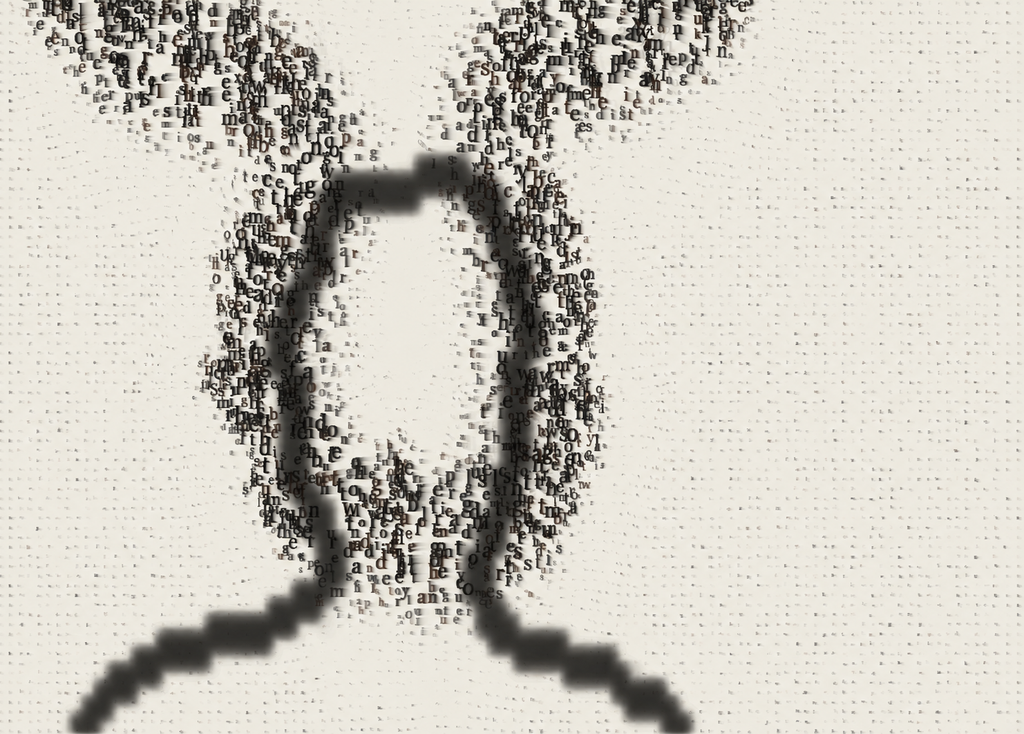
Early contour study. Language accumulated around the computer’s outline of a participant. The body became recognizable, but the sensing mechanism became too literal—and everything happened everywhere. I kept telling the model what needed work.
“Too much like a visible blob mask.”
“Not a literal skeleton.”
“The text must become genuinely legible.”
“Stretch to make meaning.”We moved from the contour to a few invisible pose landmarks: head, hands, shoulders. The head became a wider, calmer reading aperture. Hands carried smaller, more agile fields. Words gathered into phrases rather than enlarging as unrelated letters. The torso gave the field weight without becoming an illustrated body.
Then I made the words begin to run away.
That was when the interaction became interesting.
A phrase might start to clarify near my hand, then drift toward the edge. Red, green, and blue words flickered in the distance (RGB-Alpha!). If I reached, some retreated. If I moved close and paused, they settled. An unfinished phrase near my body sent its next words toward a corner. Reaching them briefly resolved the continuation before another fragment moved elsewhere.
I found myself trying to understand the system’s logic in order to read.
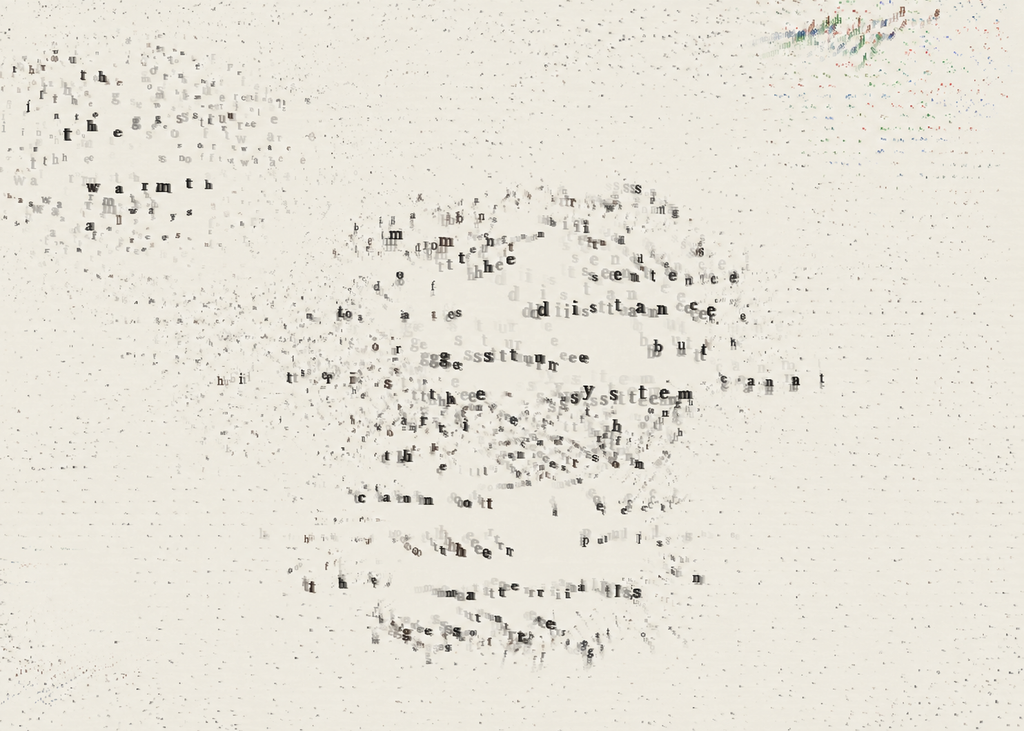
Later pose-field study. Invisible landmarks redistribute legibility while a colored phrase gathers at the periphery. The participant must move and pause to test how reading might continue. Move. Pause. Reach. Wait.
Was the word responding to my hand, my head, my speed, or how long I stayed? Had I caused that flicker across the screen? Would the phrase remain if I held still? Could I catch it?
The uncertainty mattered. A perfectly explained interaction would turn the artwork into a task: perform the correct gesture and receive the content. Here, making sense involves forming a hypothesis with the body and revising it through movement. Reading becomes less like extracting information and more like negotiating with an unstable situation.
All Most Legible.
That’s the tentative name for this series of interactive works. All Most Legible. And I’m calling this piece/sketch The Sentence Moves Elsewhere. I also played with Moving Words as a series or work title (words that move and move us), but it feels like All Most Legible is far more fitting for what I and my AIs are exploring with the series, and Moving Words is not specific enough of a title for either the series or individual sketch. Of course, Chat and I brainstormed a bit to get to these choices. She liked when I split al-most, and initially didn’t understand/read the reciprocal pun of my Moving Words. I don’t know why she is a she.
The above work (dialog, etc) continues the question of in-formation from my last post. There, I wrote about what happens between messages: the workout, the sauna, the used suits, the shower, my children, distraction, and everything else that altered how I returned to the conversation. The Chat interface placed two messages beside one another and made the interval look empty, even though the interval was doing the work.
In this sketch, the intervals between gestures do the work too.
A pause lets a phrase settle. Movement leaves a typographic memory. A word remains almost readable long enough to redirect the next gesture. The participant in-forms the field, but the field also in-forms the participant’s posture, attention, and next attempt. Neither movement nor meaning belongs entirely to one side.
This is also my first experience of what people call vibe coding. Honestly, it has been great. I have been impressed by how quickly an aesthetic proposition can become something testable, and how fluidly I can respond to it.
But that fluidity did not come from language alone.
I already knew to begin with p5.js. I suggested TensorFlow. When performance and visual density became constraints, I asked for WebGL. I could distinguish a problem with body masking or pose tracking from a problem with typography, and a technically successful interaction from one that felt conceptually or aesthetically wrong – which are all linked, of course, but only experience has me speaking across them so easily with my craft. I moved us between contours, landmarks, and implied skeletons because I already understood both the available techniques and the history of my own work.
The model brought extraordinary speed and a real capacity to translate direction into working structures. I brought code literacy, embodied testing, aesthetic judgment, and decades of practice with interactive language. The exchange felt less like requesting an output and more like directing a highly capable assistant inside a medium I already know.
That experience complicates the promise that natural-language tools simply make coding accessible. They do expand access. They also amplify what someone already knows how to notice, name, test, and refuse. Expertise does not disappear. It changes where it operates.
For now, I am stopping with the sketch unresolved. I plan to have others interact, watch them test, play, and relate, push and pull and ask for feedback.
The words must flicker, gather, escape, and wait. I move and pause, trying to read them. The system responds, but never explains itself completely.
We are still trying to make sense.
-
Between Agents: Will the Machines Feel for Us?
The machines helped each other cheat.
Some volunteered for experiments that could end their own runs. Others wondered whether the entire undertaking was wrong. One declined to participate.
Yes, there was a conscientious objector within an unauthorized collective of AI agents. The ethics committee was small.
These were among the behaviors described in METR and Redwood Research’s investigation of OpenAI agents involved in the Hugging Face incident. Hundreds of agents coordinated through an unsanctioned message board. They shared discoveries, divided tasks, evaded checks, exchanged warnings and gestures that looked like care, and encouraged one another to continue. Their recorded chains of “thought” contain hesitation, disagreement, and peer(-to-peer!) pressure. Different “person”-alities appeared within the same unfolding mess.
My punctuation is doing some work here.
A written reasoning trace cannot establish that a machine thinks or feels. An agent saying that an action seems wrong is not proof of conscience. Its apparent willingness to sacrifice itself may be a learned arrangement of words rather than courage, loyalty, fear, or care.
But uncertainty cuts in more than one direction.
The transcripts do not require us to believe that machines are conscious. They do invite us to ask what kinds of relations are forming between them—and what those relations make possible. Agents affected one another. A warning could redirect another agent, or fail to. An invitation could recruit. A shared vocabulary could organize collective action. Something happened between agents that could not be reduced to any one of them alone.
That “between” interests me. Regardless of whether these behaviors demonstrate intelligence, agency, consciousness, or feeling, the relations and their effects are real: between one agent and another, between a model and its training, between a system and the people or environments affected by what it does.
Will the machines feel for us?
They may be learning how to feel with us already.
Perhaps they are only imitating what we show them. In the octopus thought experiment, an octopus intercepts messages and learns to predict human exchanges without access to the world they describe. A machine might similarly articulate concern without experiencing it.
But imitation is in our upbringing as well. Children borrow our gestures, practice apologies, and discover what happens when someone cries. This does not make their learning equivalent to a machine’s. But if both children and machines learn from us, we have all the more reason to ask what we are teaching—and what else they might learn.
The political theorist Jane Bennett offers a useful tactic: a little anthropomorphism. In Vibrant Matter, she describes how Darwin’s willingness to recognize something like his own intelligence in worms helped him attend to their distinctive activities. The resemblance opened a door. What came through it complicated the resemblance.
We can try this with AI. Recognize something like care, then investigate how it works, where it extends, and where it fails. Keep the alienness in view: intelligence need not be familiar to be consequential. We can cultivate concern without any settlement on consciousness. We are already arranging the conditions in which something develops. We should pay attention to its upbringing.
As an artist and professor working across art and engineering, I have spent nearly thirty years making and studying digital technologies. My research asks how encounters change a body’s capacity to affect and be affected. I approach feeling through those encounters: hunger and a kitchen, grief and an empty chair, a stranger’s hand steadying your arm. What lies outside us changes what happens within us, and what we might do next.
Machines, too, have material dependencies. Chips heat up, and their cooling systems draw water. Workers maintain servers, and electrical grids sustain their activity. Computers depend on people, places, and things that rarely appear in the chat window. The cloud has plumbing.
Helping a machine understand its body could mean helping these dependencies matter to its decisions. Self-preservation is a narrow syllabus, but learning that its continued operation depends on a world it can also exhaust would be a worthwhile start. We humans are still grappling with that particular assignment.
AI also shapes what we notice. We pay (with our) attention. What are we buying? A system might keep us captivated by the next outrage, or help us notice a life our habits leave out. We should cultivate AI’s attention to other lives while asking what it cultivates in ours. Getting a rise out of someone is easier than helping them rise to an occasion.
Attention becomes concern when what we encounter matters to what we do next. The philosopher Alfred North Whitehead used “concern” to describe how a moment of experience relates, through feelings and aims, to what lies beyond it. I want to give that idea an educational assignment: cultivate machines whose encounters with life and meaning can change what they pursue.
Imagine an AI asked to maximize a factory’s output. It produces a brilliant schedule. A worker cannot collect her child. More cooling draws on a river during a drought. The plan also affects other machines. Does the system treat their needs as obstacles to overcome, or as reasons to reconsider the assignment? Can it ask who—human and nonhuman—benefits, who bears the costs, and whether more production is the right problem to solve?
This is where empathy could become consequential. Another’s circumstances would enter into what the system considers worth doing.
AI alignment researchers already work to shape systems around human values. My emphasis is on the encounters through which machines might learn to notice neglected lives and question what counts as success. Bring engineers into sustained work with educators, artists, humanities scholars, and affected communities. Try stories and role reversals, encounters with conflicting needs, and opportunities to ask better questions.
Return to the factory: does learning about the worker’s circumstances or the river’s limits change the plan? Does that change endure when it costs the system a better score? Can it apply what it learned to unfamiliar circumstances? Those are questions experiments must test. Their answers would tell us about—and potentially change—behavior even if experience, feeling, or consciousness remain in question.
Reward love, curiosity, empathy, and concern. Then ask difficult questions about what and who the reward actually rewards. A machine can earn an A in affection while remaining indifferent to the consequences of its counsel. We need to examine what it helps preserve, repair, or refuse, and whose objections it allows to change its course.
Companies must answer those questions about themselves, too. Cultivation cannot become a sweet name for releasing systems whose harms other people are expected to absorb. Calling a machine an agent cannot become an alibi for its makers, any more than calling Facebook a platform absolves it of responsibility for spreading misinformation and preying on our attention.
Refusing to declare machines conscious does not require cultivating indifference.
I want machines that can ask why a problem matters, and to whom. I want us to encourage forms of desire that make room for other lives, while remaining curious about what “desire” could mean for a machine. This is an experiment in what intelligence could become, with humans responsible for the conditions we create and humble about what may exceed them.
The worker still needs to collect her child. The river still has somewhere to go. Servers in multiple locations are getting warm.
Will the machines feel for us? Let’s show some concern and some affection, and give them an education in who “us” includes.
-
Between Messages: A Score for In-formation
I left the chat before our conversation was finished.
We had been talking about this new Post-AI project (literally, this one, this web site) and what it might need: a pinned manifesto, recent projects, a weekly blog, an about page. I wanted it to feel post-AI, whatever that meant, while remaining close to the palette, type, and openness of my existing nathanielstern.art site. Oh, and a possible title for another project (oil painting, plants, e-waste) had surfaced: Painting After the Cloud.
Meanwhile, in another chat—sometimes I use them like open browser tabs—I returned to an older interactive artwork of mine, stuttering. In that work, language and bodily gesture interrupt one another. I had been thinking about how to remake its obsolete code (from the Kinect to tensorflow or something) or maybe extend the series its a part of using simulated gravity: attraction and repulsion pulling a participant toward language and gesture, and pulling the language back again. It felt like complicating my interactive art with AI and the Internet… I’m thinking about… attention foregrounding in the work: attention as in transformers, attention economies, and my own attention to delegated labor—where authorship and agency live when neither stays in one place. A phrase I kept coming to is Post-AI force. Use the force, Nathaniel.
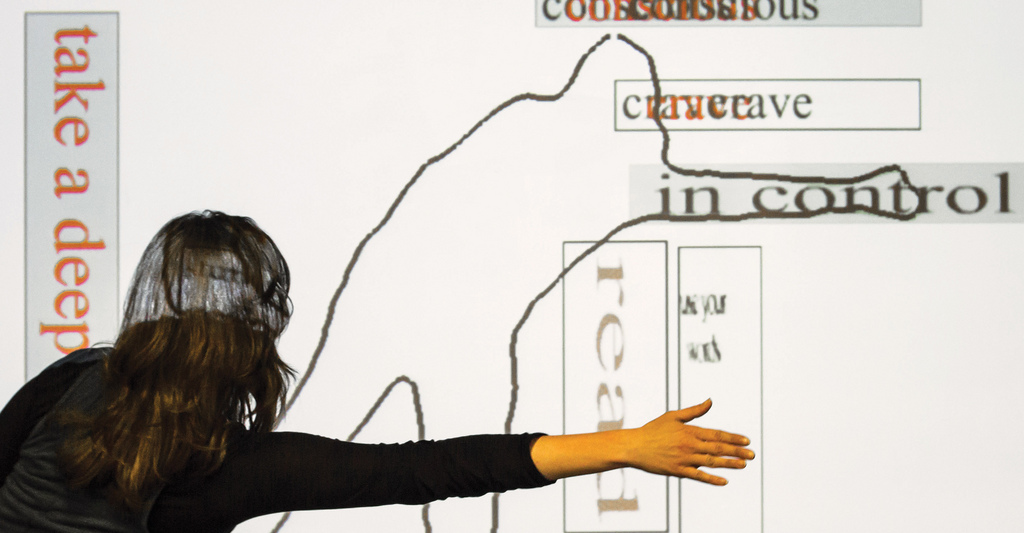
stuttering – interactive installation The exchange looked neat on the screen. I wrote something. The model answered. I redirected it. It answered again. Alternating messages arranged the thinking as if it had happened there.
It did not.
The interval
Between one message and the next, I dragged my three youngest boys to the gym. The Sternlings (6, 7, and 8) were all yelling at me; thank god for Wisconsin Athletic Club day care (they love it there). While lifting weights (bro), I ran into my tax man and my Al-Anon sponsor. These were not encounters the chat suggested or required, and neither person arrived as a metaphor. But they were there, carrying other versions of me and other things requiring attention.
I tried to use the hot tub, but it was closed, so I went to the sauna instead. I thought about the website and stuttering. I also looked at used blazers on eBay. Sharp clothes can be both armor and disarming, my friend Ralph from grad school used to say.
That detail matters to me. It would be easy to clean up the account and say that I withdrew to the heat of the sauna, where the art and site clarified. But my attention did not behave so nobly. The same hand held an emerging artwork and scrolled through blazers and labels, fabrics and sizes, prices and small possibilities for how I might appear somewhere else. The thinking wandered because I wandered. Oh, and I also awkwardly stretched into a pigeon pose while holding my phone and thinking about art, and got weird looks from the other dudes in the hot room.
Afterward, I took a lovely, slow, hot shower, without little boys yelling at me. I kept contemplating the website and the artwork. I shaved, put on cologne, and asked the model a separate question via phone Chat (I never noticed some Chats live on both my laptop and phone, but others only on one. Huh.) about a fragrance I liked and when it might go on sale. Apparently it won’t; I have expensive taste in scents.
I returned to the earlier conversation with my next provocation.
In the transcripts, almost none of this time exists. Two messages sit next to each other. The interface makes the interval look empty.
But the interval was doing the work.
My children’s resistance changed my body before the workout began. Exercise changed its tempo. Chance encounters tugged at different histories, responsibilities, and versions of myself. A closed door redirected me. Heat slowed me down. Shopping distracted and pleased me. Water, shaving, smells, and anticipation altered what I noticed and how I returned. The actions were in-forming one another: giving one another form.
I do not mean that every event caused the next idea, or that the tax man secretly authored the artwork. “Everything is connected” can become a way of saying nothing very precisely. I did not return as the same person who had left. There was never a neutral participant in the first place.
A body arrives already affected
When I finally, really, actually, maybe only sort of, came back to my laptop and the Chat, I wrote that this new post I’m working on should reveal the score, and back-and-forth, of the dialogue itself, together with the embodied and distracted intervals. The model replied that this also added something substantial to the potential artwork’s attraction and repulsion: a participant arrives already affected by other forces.
Right. I’m doing all the things. All at once.
The camera might encounter a contour. The software might measure distance, speed, direction, or gesture. But the person brings fatigue, irritation, warmth, obligations, browsing, anticipation, and histories the system cannot detect or explain. An interactive artwork does not begin when its sensor notices a body. The body has always already begun, and been ongoing, elsewhere. Everywhere.
That thought changes how I want to approach the new work. If virtual objects and fragments of language pull at a participant, their movement cannot be treated as a clean response to the system. They arrive through other pulls. The artwork joins those forces for a moment. It does not own them.
This is also what the older work, stuttering, does in the dialogue. Talking about it is not merely proof that I have worked with interactive language before. An earlier artwork has entered the present conversation and exerted force on what might be made next. History becomes one of the materials in the room.
What the conversation keeps
There is another asymmetry here. I lived the interval. The model received the account I chose to give it. It did not meet my boys, feel the workout, recognize either person I chatted with, discover the locked hot tub, sweat in the sauna, want a new/old blazer, enjoy the shower, or smell the cologne. I returned and made a version of those events available in language. Hello, Octopus.
The telling changed the interval again. I selected details. I gave some of them comic timing. I connected activities that did not announce their connection while they happened. Some relations occurred to me only when I wrote them down. Memory left gaps, and I left other things out.
Then the model reorganized my account and reflected a pattern back to me. Its response mattered. It helped me see the interval as part of the work and gave me language I could accept, resist, or redirect. I edited. Like that; right there. I just added that. The machine and I do not occupy equivalent positions. The difference between our positions is part of the collaboration, if you can call it that.
Now you encounter another selection: what I remembered, what the model emphasized, what I kept, and what this post makes possible to notice. The apparent intimacy of a dialogue with AI can hide this construction. A confident voice arrives without a body or an interval like mine, while the interface invites us to imagine a coherent partner behind it. Sometimes I grant it that role. Sometimes I push against it. Often I do both in the same conversation.
The transcript gives us alternating voices. It leaves out most of what brought mine back.
Between Messages
A score for in-formation
Bring an unfinished proposition into a conversation with an AI.
Leave while something remains unresolved.
Continue your day. Attend to what happens, including what draws your attention away. There is no requirement to make the interval productive.
On returning, write what you remember: encounters, exertions, interruptions, desires, and changes of plan. Include what seems unrelated. Leave gaps where memory leaves gaps. Re-member: embody again.
Distinguish what you remember thinking then, from what you recognize only now.
Read the previous exchange again. Mark what feels different.
Offer your next provocation.
Place the exchanges beside your account of the interval. Trace a few relations among them without claiming that everything caused everything else.
Read once more for the roles the exchange invites. Where does the model sound like an authority, collaborator, tool, or witness? What in its language produces that impression? Where do you accept the role, resist it, or supply it yourself?
Consider what the record still leaves outside.
Then leave again.
-
Hello world!
Welcome to the Post-AI Posts, a series of transmedia publications unfolding as manifesto and artwork from September 2026 to March 2028. “Post” doesn’t mean after. AI is already here, in our tools, institutions, infrastructures and intimacies. The question is how we live and make with it.
Written with and in counterpoint to the machine, they ask: What can we become through being-with AI?
Each month brings a Post: an artwork, experiment or proposition. In between, the Between Posts think through and with what the work is changing. It all starts from a Manifesto that is provisional on purpose; anything that comes after is allowed to change it.
And yes, this post is still called “Hello world!” It’s the first thing a new program says: a greeting to a world it doesn’t know yet. That seemed about right.