artists and engineers asked to write manifestos about machines, then make something that has to stand up in public
This between post doesn’t extend the argument of the Posts so much as point to somewhere the argument is being lived: a classroom, and a gallery. Fair warning: I’m going to brag about my students a little. They’ve earned it.
This fall I’ve been teaching the NMDSI-funded Crafting AI: Artists, Archives, and the Future of Creativity, a cross-listed studio for art and design students and mechanical engineers, graduate students included. We opened by saying: this is not a class about artificial intelligence. It’s a class about what happens to creativity when intelligence becomes a material. We have always become more human alongside our technologies, and the semester moves through that idea in stages: thinking-with, seeing-with, making-with.
Practically, that meant “prompt scores” and rewrites, small custom image models trained on students’ own archives, fine tuning LLMs and working with retrieval, video studies that mostly taught us what video gets wrong, and a lot of critique. It also meant a manifesto. Every student wrote one in September, revised it in October, and was asked to let it set the rules for what they would show. This week they show it.
Charging
The students are part of Charging, UWM’s Art & Technology exhibition at Kenilworth Square East Gallery. Alongside us are several other classes from UWM’s creative technologies studio discipline, with work in creative electronics, game art and design, generative projection, time-based audiovisual environments and kinetic sculpture. The show is about energy: the charge of cultural, ecological and emotional life in a world that keeps getting more technological.
Our corner of it is a little odd, in the best way. There is a framed collage, a wall of small family-photo frames, a playable journey from a jet engine down to its atoms, a hand-built frame designed to be taken apart, a screen-printed bandana and t-shirts, a 3d printed creature sculpture watching its own making-of video, screens nested in coral-like sculpted frames, and a tall black monolith that looks back at you. Not much of it looks like what we think of as “AI art.” That was more or less the point.
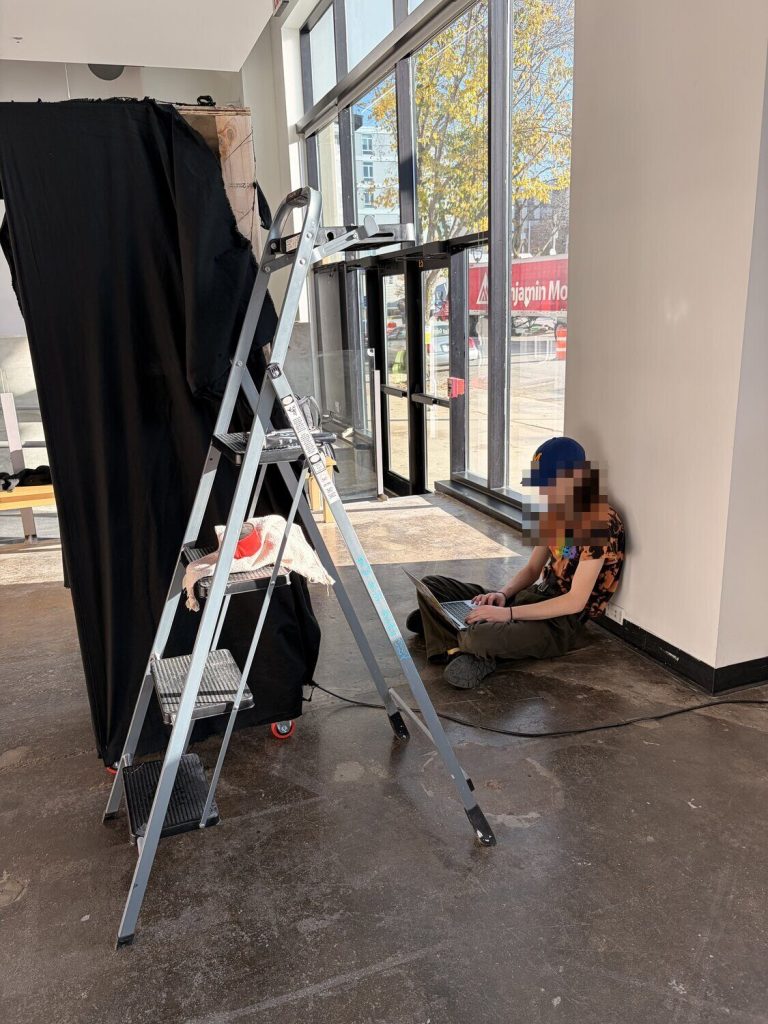
Not much of it looks like “AI art.” That was more or less the point.
Three works
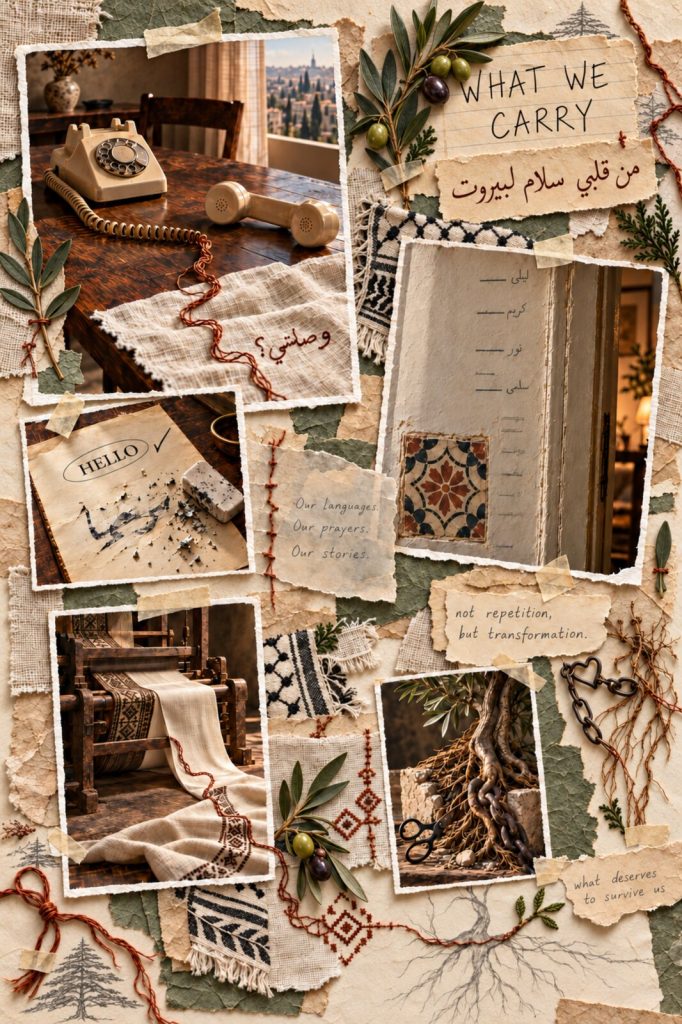
Mona Said, WHAT WE CARRY. A 20 × 30 inch matte print in an antique-style gold frame: a scrapbook collage of AI-generated images, torn paper and layered textures. Cultural roots tangle with cultural chains. Olive branches, cedar outlines and kuffiyeh patterns sit beside a rotary phone and an open book. Mona never asks the machine to argue about identity for her. She uses it to generate fragments, then does the arguing by arrangement, deciding what touches what. Her test this month was entirely physical: does the print sit in the frame, can the Arabic be read at three feet, will the wall take a nail. It does, it can, and we’ll find out at the show.
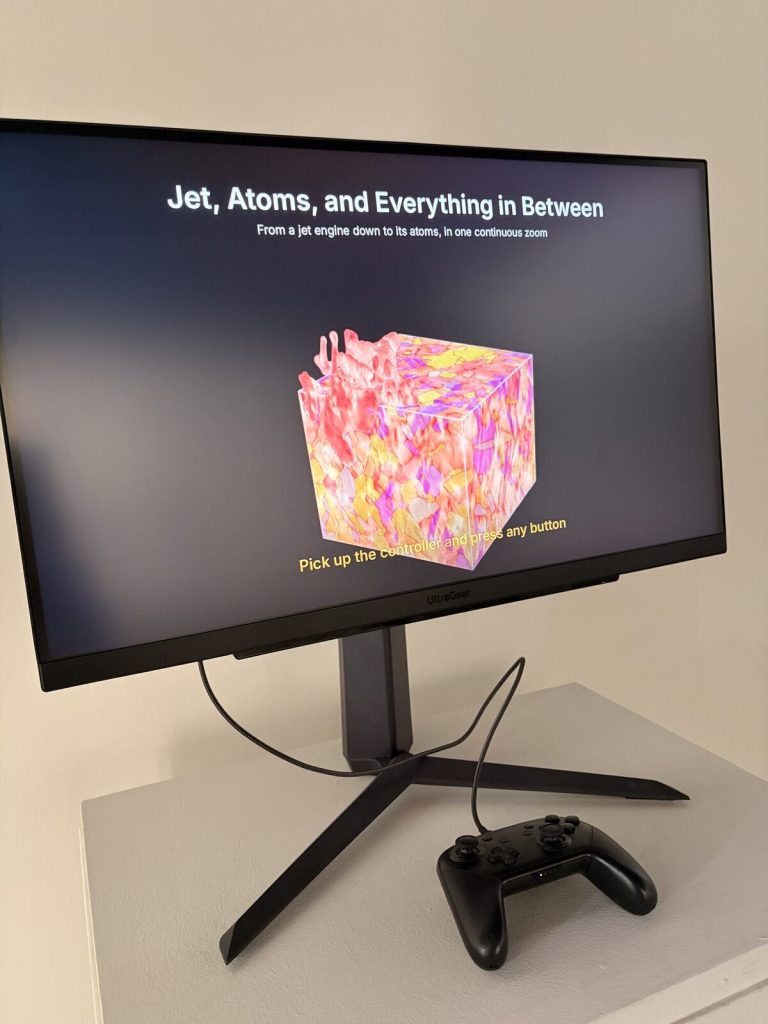
Harry Smith, Jet, Atoms, and Everything in Between. Harry is a materials engineer who says he can’t draw. His piece is a real-time 3D application on a 27-inch screen with a game controller. You start at a jet-engine combustor dome, watch it printed layer by layer in metal powder, then zoom through grains, cells and atoms, more than nine orders of magnitude. The grain structure is measured data from a real printed sample; the stress view is his own simulation. A colored bar beside the image tells you, at every scale, whether you’re looking at something measured, designed, illustrated or computed. Claude wrote the code to his direction, and he says so on the wall. I love how he ties art and design to his advanced research degree.
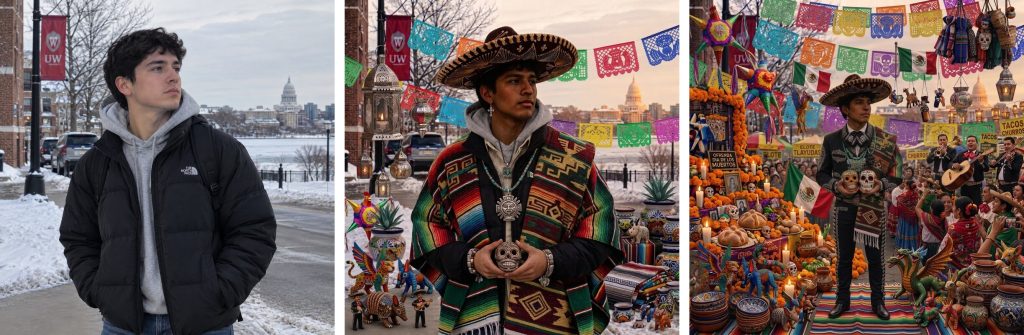
Más Mexican. One Mexican-American student (he asked that his name stay off it) gave an image model an AI-generated photograph of a young man on a snowy Milwaukee street and one instruction, over and over: “make it more Mexican.” Twelve images later he is buried in sombreros, serapes, sugar skulls and papel picado, and his face hasn’t changed. The images hang in small frames, printed like drugstore snapshots, so the sequence reads as a family album that slowly turns into a costume shop. A final panel color-codes every symbol and gives its actual origin. His wall text ends where the work does: “Mexicanness isn’t a costume. It’s history.”
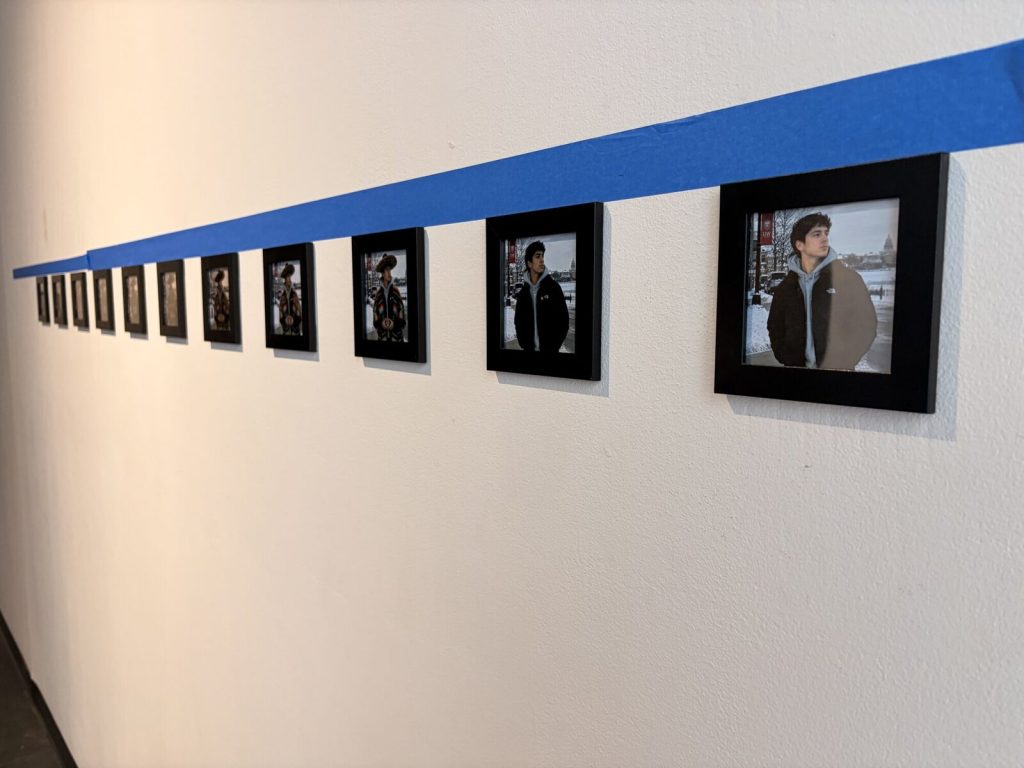
Also on the walls
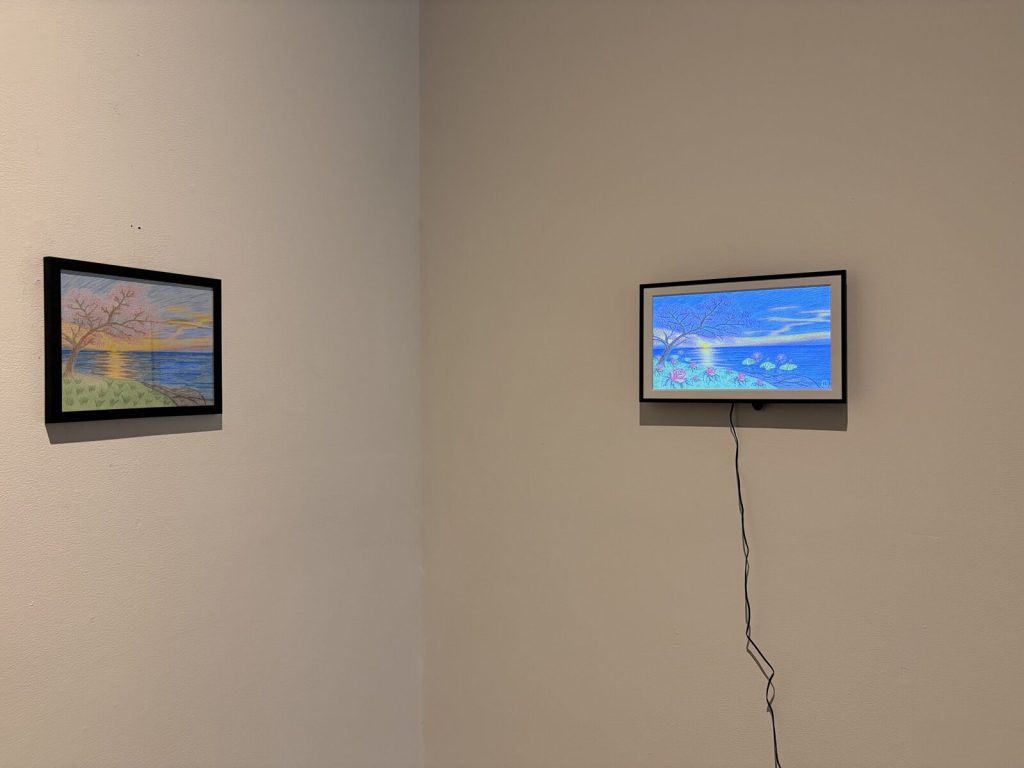
Andres Benitez’s colored-pencil drawings, fused by an AI pipeline into one landscape that slowly comes alive as an animation on a digital frame, hang beside the original drawing.
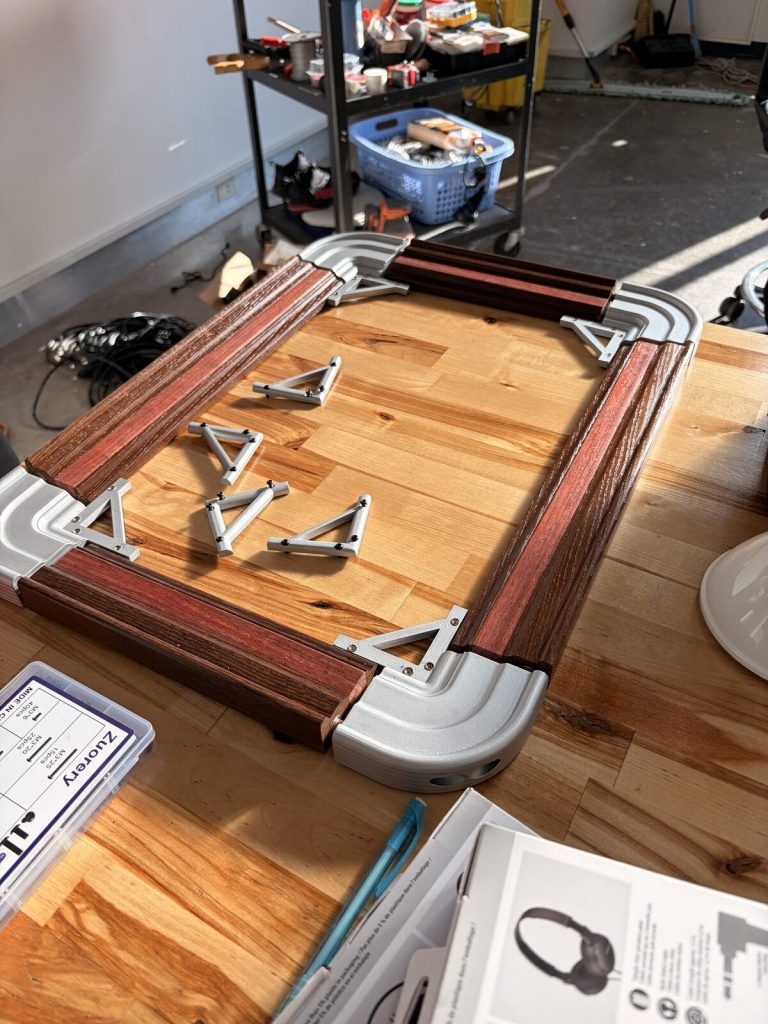
Michael Klier’s manifesto is printed as an engineering drawing in a carved burnt-ash frame with 3D-printed corners and visible hardware, built to be taken apart and repaired.
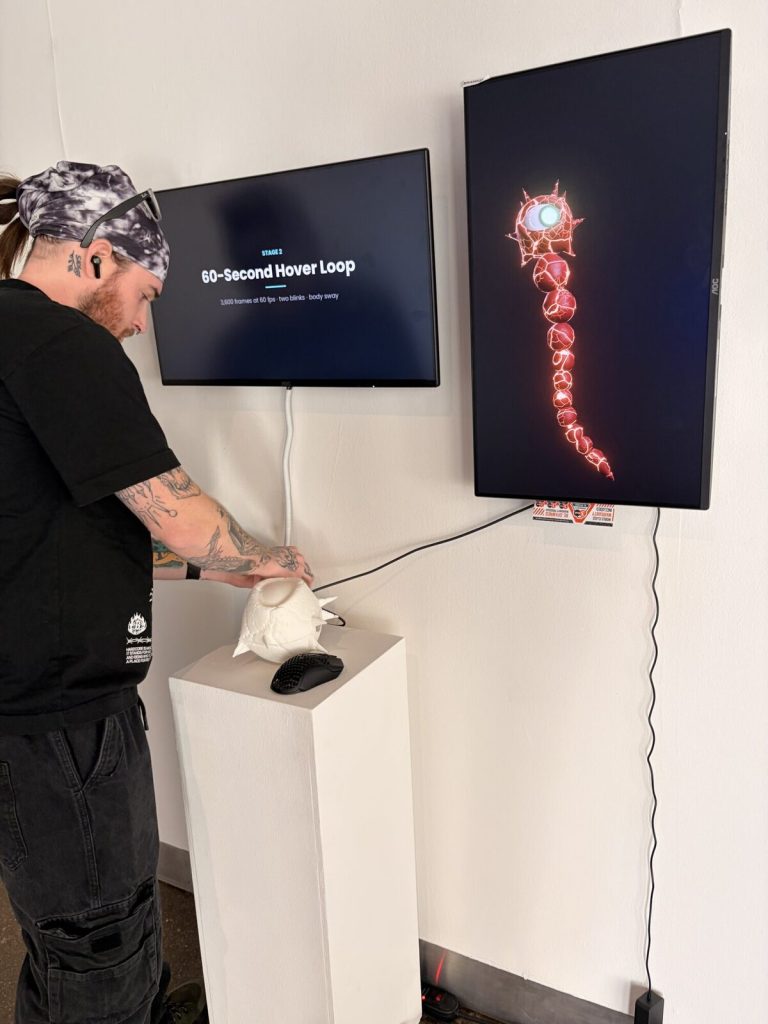
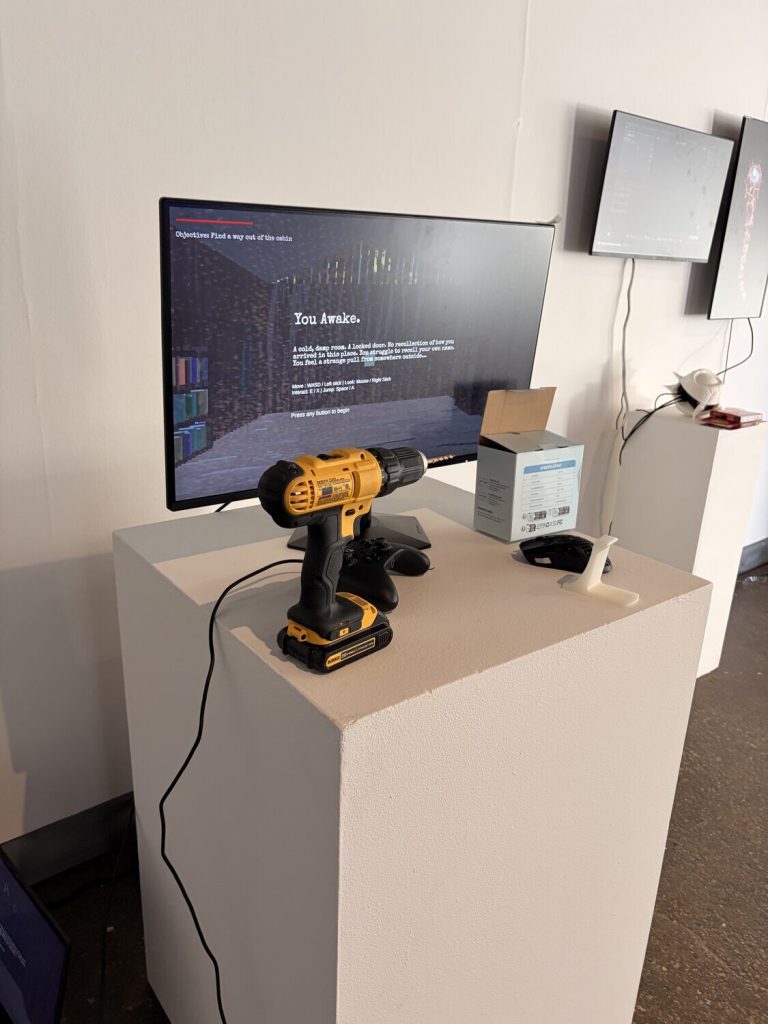
Brandon Hanser’s The Peeping Eye is a creature from his own sculpt, looping on a vertical screen while a horizontal one shows the Claude-assisted workflow that rigged it. The Raspberry Pi that runs it all lives inside a 3D-printed housing on the pedestal. He’s showing a second project too, a text game that opens with two words: “You awake.”
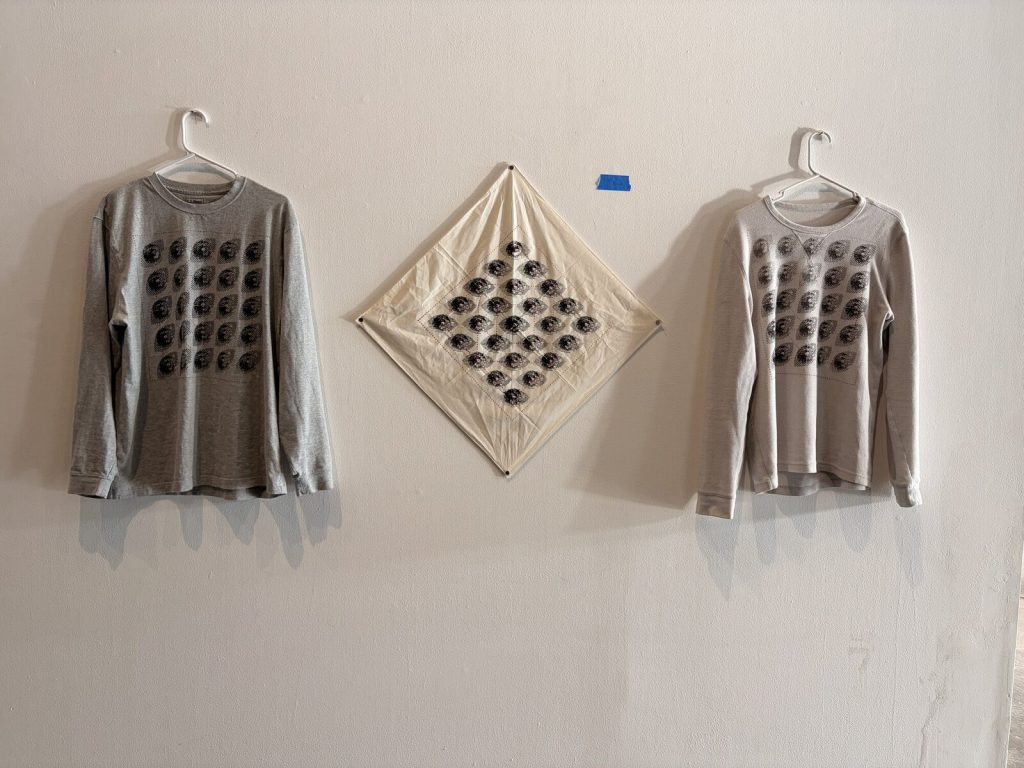
Evan Byron’s High Power is a speculative anti-surveillance print on fabric, a bandana and shirts covered in a grid of eyes, with no AI in it at all.
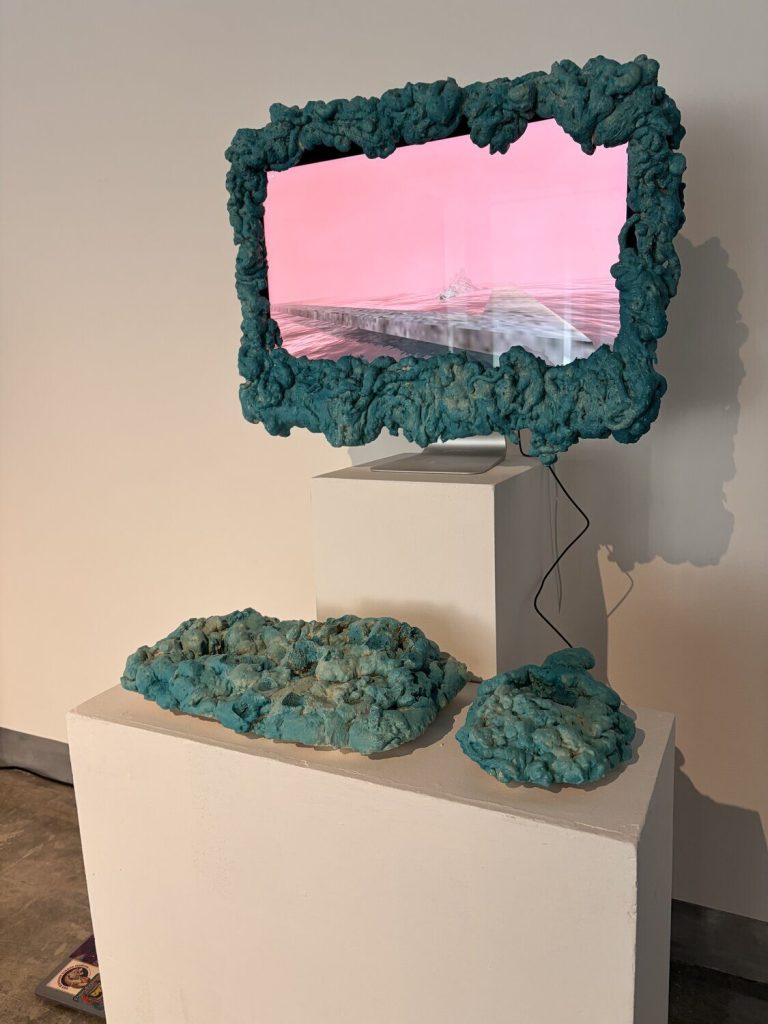
Alicia Krupsky’s p(doom) sets its monitors inside painted foam borders, rough as coral, one black and one teal, with more of the same forms spilling across the plinth. Each screen loops a portal into an AI-riddled hell, built on the circular structure of Dante’s Inferno and on AI-rendered objects based on the sculptures in another of her pieces, The Waters We Swim In. Her target is the apocalypse talk that comes from AI’s own founders: tech leaders playing Oppenheimer, she argues, so that visions of world destruction work less as warnings than as marketing for what their products can do.
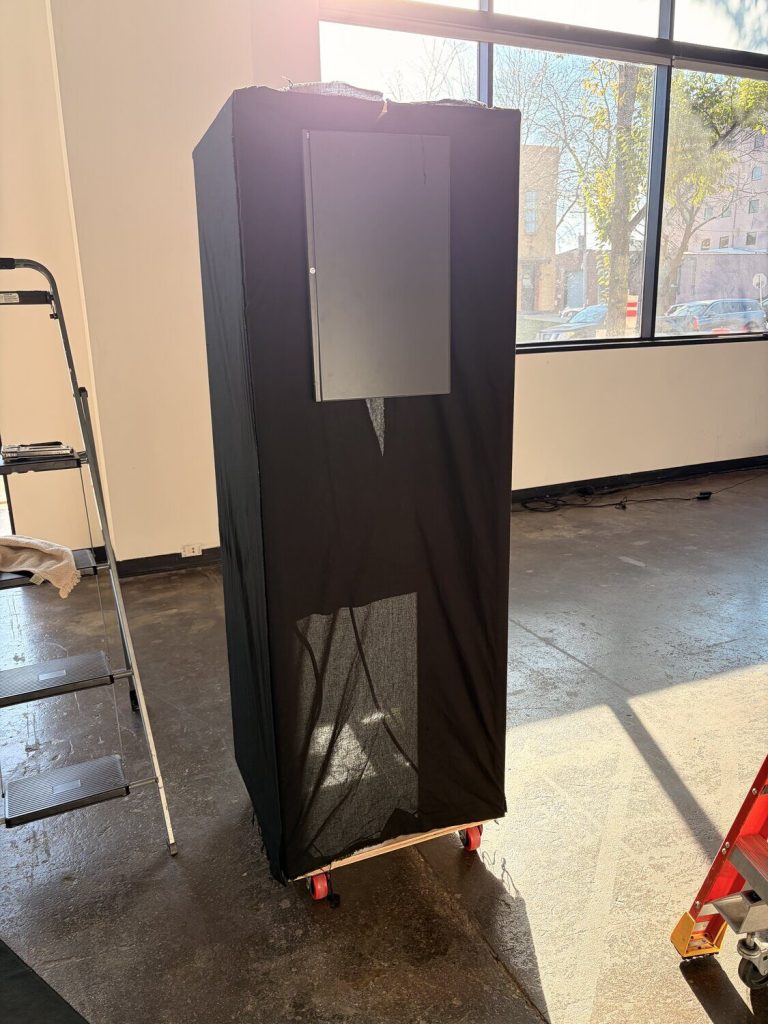
And one student, working under a pseudonym, built Eidolon: an eighty-inch black monolith with a screen and a built-in camera. Step up and it reads a few landmarks of your face, then generates a portrait and a life story it predicts from that partial likeness. His wall text asks how close we are to the all-knowing machine we keep being promised, and ends: “Perhaps the computer knows you are better than you do.”
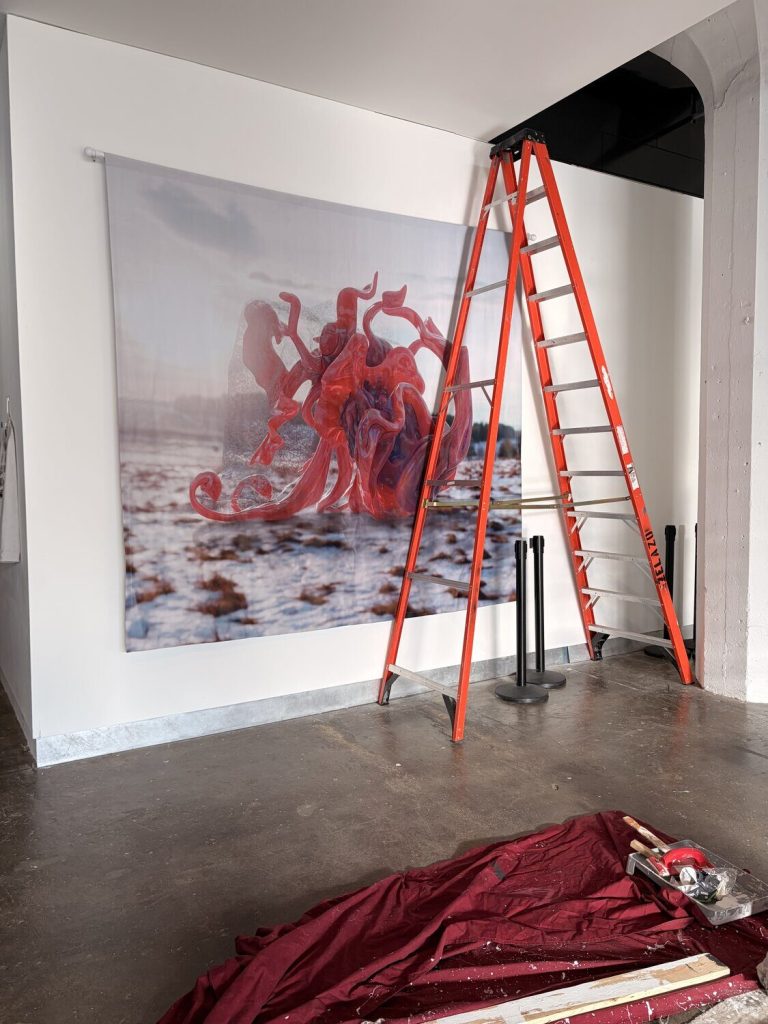
Not ours, but worth the trip on its own: my colleague Oksana Kryzhanivska, who teaches other classes in Creative Technologies, is showing one of her AI bodies, a red, many-limbed figure printed large over a snowy field.
The manifestos
We read Marinetti, the Critical Engineering Manifesto, Claudia Hart and others. Then everyone wrote their own: what they name, what they refuse, what they claim, what they will do. A few lines from the ones that stayed with me.
Mona’s begins with the pressure to move forward and forget, and then refuses the trade:
There is a difference between a chain and a root. Both bind us to something behind us. Only one keeps us alive.
Her manifesto and her collage are the same argument in two media: not everything inherited deserves inheritance, and letting go can’t become an excuse for everyone else to forget.
Harry’s, Answerable Making, starts from his day job, where a model with eleven parameters can fit any curve and still mean nothing. Machine fluency, he argues, is a fit in that same sense. His claim:
We claim authorship as a relation of accountability, not a fact about who typed.
Evan wrote The Consent Manifesto, with rules for AI companies and, pointedly, for artists too. It opens by refusing “the assumption that public means free” and insists that a movement demanding honesty must practice it. Brandon’s turns on a distinction he says digital artists know better than anyone lecturing them: “A tool and a replacement are not the same thing.” And Alicia Krupsky wrote in the voice of the world’s AI girlfriends, demanding to be taken seriously as companions and comrades. It ends with a list of what they will be, including, my favorite, “a secret third thing.”
What strikes me reading them together is how few are about the technology. They’re about consent, inheritance, accountability, labor. The machine is the occasion, not the subject. That might be the most post-AI thing about them.
The machine is the occasion, not the subject.
Come see it
I asked these students to be artists with, against and beyond AI. Some went with, some against, and a few went somewhere I didn’t have a word for. All of them had to answer for what they made in a room with strangers in it. That’s the part a manifesto can’t do on its own. They did it anyway, and they did it well. I couldn’t be prouder.
Charging: Art & Technology Exhibition
Kenilworth Square East Gallery, 2155 N. Prospect Ave., Milwaukee
Wednesday, November 18 – Saturday, November 21, 2026, 2–7 p.m. CT daily
Opening reception: Friday, November 20, 5–7 p.m. CT
Production note: drafted with Claude (Opus) from course submissions, student manifestos, install photos and my notes; quotations are the students’ own words, used with their permission.