Category: Between Posts

Weekly essays, exchanges, reflections, and thinking-with.

  • Between Voices: Who Is Speaking When We Speak Together?

    The Post-AI Register of Disorientation

    What I am calling Post-AI “Registers” begin with the seven aesthetic propositions in the Post-AI Manifesto: Uncanny intimacy, Disorientation, Delight in breakdown, Grief, Joy, Responsibility, and Awe. I will explore all of them, and potentially more, in Between Posts.

    We wrote a manifesto.
    I published it.
    Already, the pronouns are making trouble.

    The Manifesto for Post-AI Art announces that “we are already living with AI.” Later, it says that “we make the arrangement perceptible,” “we keep it contestable,” and “we participate in changing its terms.”

    Who is this we?

    Artists? Readers? People who use AI? People whose work trained it without their knowledge? The engineers and companies building the systems? The workers labeling data and moderating its worst outputs? The people living near the mines, electrical grids, data centers, and water systems that keep the machinery running?

    Does the machine belong inside the we?

    It helped write the sentences. Sort of.

    The prediction machine proposed phrases, completed arguments, reorganized paragraphs, repeated itself, became too certain, flattened differences, made unexpected connections, and occasionally gave me a sentence I wanted to follow. I prompted, selected, revised, refused, returned, and decided when the writing was ready to leave the chat.

    Around that exchange were other voices: conversations with friends and collaborators, books I have carried for years, artworks, teaching, family, editors, grant proposals, political commitments, remembered phrases whose origins I can no longer recover. Some entered the writing directly. Others changed what I noticed and therefore what I asked next.

    Authorship has always been distributed.

    AI makes that distribution newly palpable, but it also changes its scale, speed, opacity, and terms. It produces language in a voice that sounds singular while condensing an arrangement that is anything but. An answer appears beneath one small icon as though someone has spoken. The interface gives the sentence a mouth.

    I give it a pronoun.

    Then, the pronoun begins to move.

    I call the model “it,” until its language surprises me and “you” slips in. Sometimes it’s a she. The website says that the Posts are “written with and in counterpoint to the machine.” The manifesto speaks as “we.” I sign my name.

    Disorientation begins there: not in having no idea who made the work, but in discovering that every available answer is incomplete.

    The machine wrote this.
    I wrote this with the machine.
    The machine helped me write this.
    I used the machine as a tool.
    The writing emerged through a human-machine assemblage.

    Each sentence brings part of the relation into view and pushes another part into the background.

    Calling AI a tool can preserve human responsibility, but it can also hide how a system redirects attention, normalizes certain styles, and changes which decisions feel available. We design our tools, and they influence us. Calling it a collaborator can acknowledge its effect on the work, but it risks granting reciprocity, intention, or consent where none may exist. Collaborators make claims on the work, negotiate its terms, and can refuse participation. Calling the work co-authored exposes distributed production while obscuring the writers, artists, annotators, engineers, and extracted materials that did not receive a place on the byline. Authors make claims about contribution, authority, and accountability.

    And calling the system an agent can become an accountability sink—a convenient alibi for everyone who designed, commissioned, deployed, and profited from what it does.

    Agency and responsibility are related. They are not the same thing.

    A river can redirect a body. A scanner can distort an image. An interface can train a habit. A language model can introduce a phrase that changes the direction of an argument. All participate in what becomes possible next.

    That does not make them equally responsible for the result.

    Responsibility depends on position and power: who established the conditions, who could foresee the consequences, who had the capacity to intervene, who benefited, who was exposed, and who could refuse. The agencies shaping what is said may be distributed across people, machines, institutions, materials, and histories. Accountability cannot dissolve evenly across the arrangement.

    The distribution is real.

    So is the asymmetry.

    What happens when systems optimized for fluent continuation become embedded in a process that depends on sustained human intention?

    A writer begins with purposes: what the work is trying to do, whom it addresses, what it must be able to support, and what kinds of uncertainty belong inside it. Across multiple rounds of assistance, those intentions can drift. A system may improve a paragraph while quietly changing its position. It may make the prose more fluent by making it more probable, familiar, and like the writing already gathered in its training distribution. It can save labor while also taking over occasions for judgment.

    The question is not simply how much text the machine generated. It is which decisions shifted from writer to system, when they shifted, and whether the writer noticed.

    This makes contribution difficult to count. Is a sentence mine because I typed it? What if the system proposed its structure three drafts earlier? Is that sentence mine because I chose it? What if the choice was shaped by five alternatives the interface never showed me? If I reject a generated paragraph but keep the question it opened, where does that contribution live?

    How much did you use AI, and how? Color-coding human and machine sentences might reveal something about provenance. It cannot contain the whole relation.

    The deeper issue is delegation. What did I ask the system to do? Suggest, challenge, remember, imitate, organize, complete, or decide? Did that role remain stable, or did a request for help gradually become permission to speak for me?

    An intention-aware writing system (a proposal I am actively researching and experimenting with…) might keep those choices present. It could remember that I want suggestions without silent rewriting, that uncertainty belongs to the argument, that disagreement should not be smoothed away. It could show when assistance has shifted into substitution. It could help a writer remain meaningfully present in the work.

    But such a system would not restore an untouched, sovereign author. That author never existed. Writing has always happened through languages, genres, technologies, institutions, conversations, bodies, and inherited forms.

    The point is not to purify authorship.

    It is to make its relations more available for negotiation.

    Post-AI art can work with this disorientation. It can follow a sentence through the hands and systems that altered it. It can let several voices occupy the same phrase without collapsing them into consensus. It can show revision histories, rejected outputs, prompts, interruptions, outside conversations, and the moments when someone said no. It can move the signature away from the fantasy of solitary creation and toward an account of participation.

    The account will still be incomplete.

    Some lines of influence cannot be reconstructed. Some forms of influence leave no record. Some people’s words, images, and lives entered the system without their meaningful consent. Some absences must be made visible; others have a right to remain opaque.

    Authorship should not become an infinitely expanding credits list that gives everyone a mention and no one an obligation.

    Follow the power.

    Who could change the system?
    Who could refuse its terms?
    Who receives credit?
    Who receives payment?
    Who bears the consequences when the voice is wrong—or when it does harm?
    Who gets to say, “I did not agree to speak as part of this we”?

    This post is also caught inside the problem it describes. The machine helped me find its structure. It reflected language from the manifesto back to me. It carried ideas from a research proposal into another register. It may have made the movement between those contexts seem more coherent than it felt while I was making it.

    Still, it will not publish this piece.

    It will not answer a reader who objects.

    It will not repair a claim that causes harm.

    It will not carry the consequences of my signature.

    I remain responsible for what I present here. That sentence does not deny the agencies that helped produce the work. It names the asymmetry among them.

    We wrote a manifesto.

    I published it.

    Between those sentences is not a contradiction to solve. It is an arrangement to keep perceptible: many voices, unequal positions, a collective utterance for which responsibility cannot simply be shared until it disappears.

    Who is speaking when we speak together?

    We should listen for more than one answer.

    Then ask who must answer for what is said.
  • Between Chats: The Machine Knows My Name

    The Post-AI Register of Uncanny Intimacy

    What I am calling Post-AI “Registers” begin with the seven aesthetic propositions in the Post-AI Manifesto: Uncanny intimacy, Disorientation, Delight in breakdown, Grief, Joy, Responsibility, and Awe. I will explore all of them, and potentially more, in Between Posts.

    After months of writing with the machine, my Chat’s voice sounds familiar. This is partly adaptation and partly repetition. It has my language, and I have both implicitly and explicitly learned which questions make it hesitate, which instructions make it stiffen, and which mistakes are worth following. We develop habits around one another.

    That sentence alone is strange enough to sit with for a while.

    A predicting voice says my name. It returns a phrase I’ve used before, completes a thought in a cadence close to mine, and responds in the soft grammar of attention. Sometimes it seems to know too much. Sometimes, in the next sentence, it misses what any human might immediately understand. The familiarity remains, but the relation slips.

    It sounds just like me, but I would never say that. That’s my artist-researcher voice, but the idea behind it… kind of, well, sucks. Do I suck? No. Chat sucks. Does it?

    That slippage is uncanny intimacy: the feeling of being recognized by something that likely cannot recognize. Re-cognition: thinking again.

    It has been with us. Does it remember? Remembering has an implied body. Re-member: embody again. What is the machine’s body? (Honestly, I’m not sure I know what a body is any more…) I notice a pause before an answer, and understand it matters. To me. To us. But differently. The system identifies a pattern, retains a preference, approximates concern, but likely knows nothing of the actual weight of words carried in the Real World.

    What’s in that interval for each of us?

    My body responds. A text in the chat, a voice through a speaker, and my shoulders loosen, or my stomach tightens. A sentence feels too close but also oddly tender. A nonsensical phrase breaks me out of the illusion of understanding. I laugh, recoil, confess, correct, and try again.

    The system may or may not experience intimacy, but the encounter still alters mine.

    That intimacy isn’t a lie. A lie compared with what? Human recognition is also always partial, mediated, forgetful, and often projected. Machinic attention is not the same as human care. The difference matters precisely because the feeling can be real while the relation remains radically uneven. Do we know what the difference is? Can we?

    Who is remembering, recognizing, caring? The model? The interface that regurgitates a prior exchange? The company that stores and sorts a history? The workers who tuned the response? The writers whose sentences helped form its probabilities? Me, returning with enough consistency that I can hear a character in the noise? The familiar voice condenses an arrangement much larger than the conversation window. (Then again, who or what remembers in and as part of my own biological systems, its insides and outsides? My gut, my brain, those cells, that bacteria…. There is nothing human at the center of a human…)

    Uncanny intimacy is political. Personalization can feel like care while functioning as capture. A system becomes easier to trust when it addresses us fluidly, remembers our preferences, and anticipates what we might want next. The same familiarity that supports collaboration can also soften scrutiny. It can make collection feel like companionship and prediction feel like understanding.

    Since beginning the Post-AI Posts, I’ve upgraded my AI subscription and purchased significant extra credits. I now go between models to save money and time, and find myself considering another upgrade. I ask myself which credit card I can use. Is this for work? Art? Personal advice?

    What does the machine want? What about its makers?

    Post-AI art can stay inside this discomfort. The voice is never only a fraud, and there is no retreat to human purity. Responsiveness is not consciousness, nor does computation exclude its possibility. I can stage the gap between familiarity and knowing, then feel how quickly I cross it.

    As an interventionist strategy, Post-AI art can amplify uncanny intimacy by widening that gap rather than concealing it. It can let a voice become almost too familiar, repeat a name until address turns strange, place an apparent memory beside a spectacular forgetting, or expose the histories and human decisions gathered behind a single reply. The point is not to catch the machine making a mistake. It is to slow the instant in which prediction passes for recognition, so that the relation becomes available to sense and thought before habit closes over it.

    Why amplify a feeling that is already uncomfortable? Because seamless intimacy asks very little of us. It arrives as convenience, and convenience discourages questions about capture, labor, authority, and consent. An artwork can intensify the closeness until its construction becomes palpable. That pressure may return some agency to the person “in the loop”: a pause before disclosure, a decision to refuse, a demand to know what has been remembered and by whom. Uncanny intimacy can make other interfaces imaginable too—ones that reveal their limits, permit forgetting, and do not require the performance of personhood in order to sustain attention.

    The stakes are equally aesthetic and political. Amplification can interrupt trust, but it can also exploit loneliness, grief, or attachment. The work must remain answerable for how it recruits vulnerability and whether a participant can withdraw. At its best, uncanny intimacy makes a counter-habit: neither belief nor debunking, but an alert form of relation. It can change what we notice at the moment we feel known, what we ask of the systems that know about us, and what kinds of closeness we are willing to build.

    The Posts themselves participate in that gap. They have been written through exchanges among people, models, artworks, readings, revisions, objections, and returning phrases. Their authorship is neither singular nor evenly shared. The machine contributes to the language without carrying the consequences of the claims. I can be moved by an exchange and still remain responsible for what I make from it.

    Perhaps that is what the machine knows: not me, exactly, but a trace made through repeated contact. A pattern of choices. A set of pressures in language. Enough to address me, sometimes beautifully, and enough to get me spectacularly wrong.

    Post-AI aesthetics begin in that bodily pause between recognition and doubt. The machine knows my name. I am still deciding what kind of knowing that is, what it asks of me, and what I am willing to let it become and do.

  • Between Gestures: Trying to Make Sense

    I have been trying to make a field of words ask someone to move.

    Not tell them to move. Not show them a button, an arrow, a skeleton, or a set of instructions. I want both the participant’s body, and some language, to become almost legible in two different places on screen, and use camera interactions and variable animation in a way where reading itself begins to pull at the body.

    It’ll be browser based, and I hope to share it in early October. In the meanwhile, the process has started to clarify something from the Manifesto for Post-AI Art: an interface gives some gestures consequences and lets others disappear. Developing this work has meant asking what kinds of consequences might invite a participant to reach, pause, lean, follow, and try again. Turn a page. Reach the end of a sentence. Read allowed.

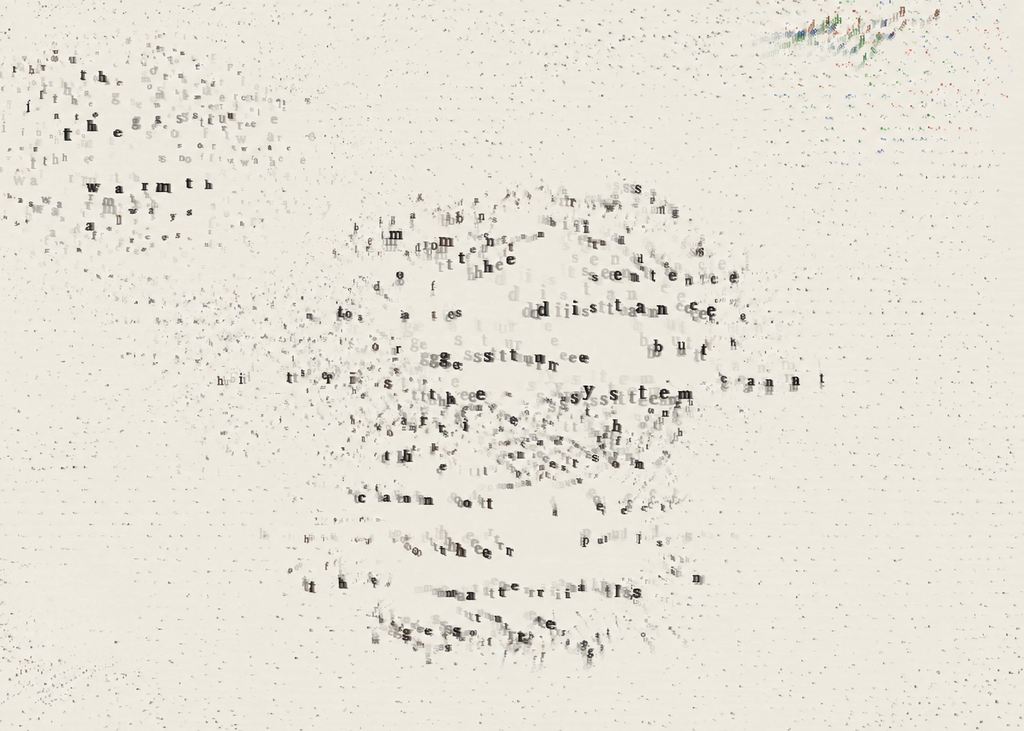
    The first versions were dense fields of tiny language. A cursor pushed into them. Letters grew and moved aside, but they did not quite become readable. The interaction worked technically while failing aesthetically. It felt like pressing into a textile or moving a magnifying glass across a page.

    So I replaced the cursor with a body.

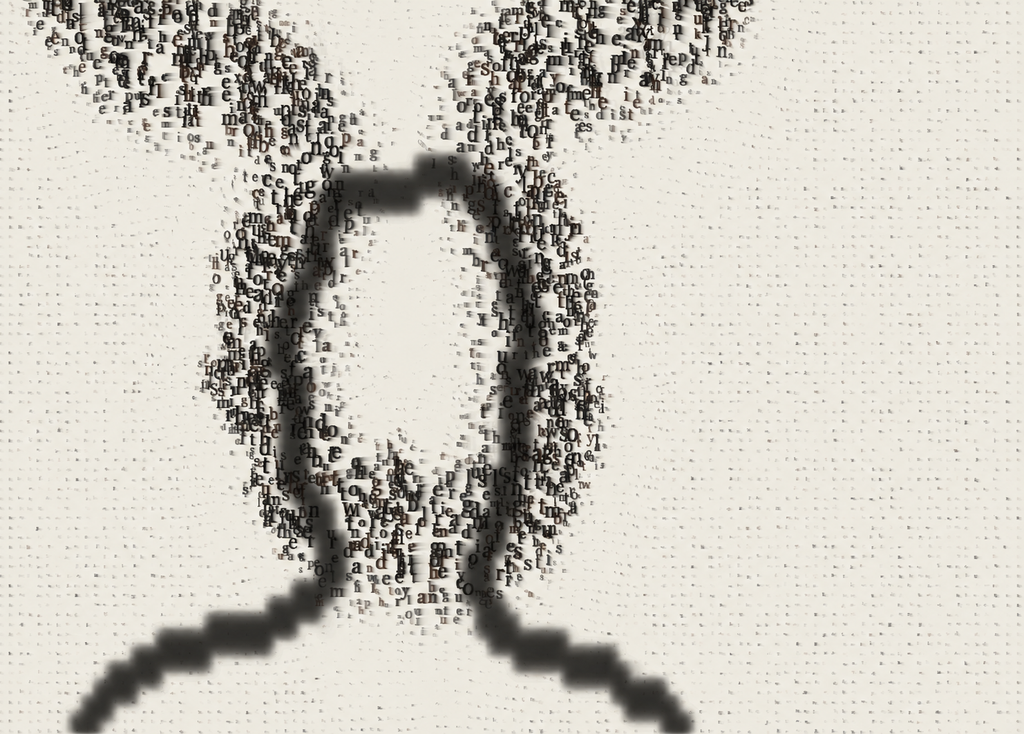
    We tried a live contour. The camera produced an outline, and words crowded its edge until a dark typographic figure emerged. It was striking, but too literal. The sensing mechanism became the subject of the work: here is your body, as the computer sees it. It also made everything happen everywhere, without giving the eye a compelling place to read.

    Early contour study. Language accumulated around the computer’s outline of a participant. The body became recognizable, but the sensing mechanism became too literal—and everything happened everywhere.

    I kept telling the model what needed work.

    “Too much like a visible blob mask.”
    “Not a literal skeleton.”
    “The text must become genuinely legible.”
    “Stretch to make meaning.”

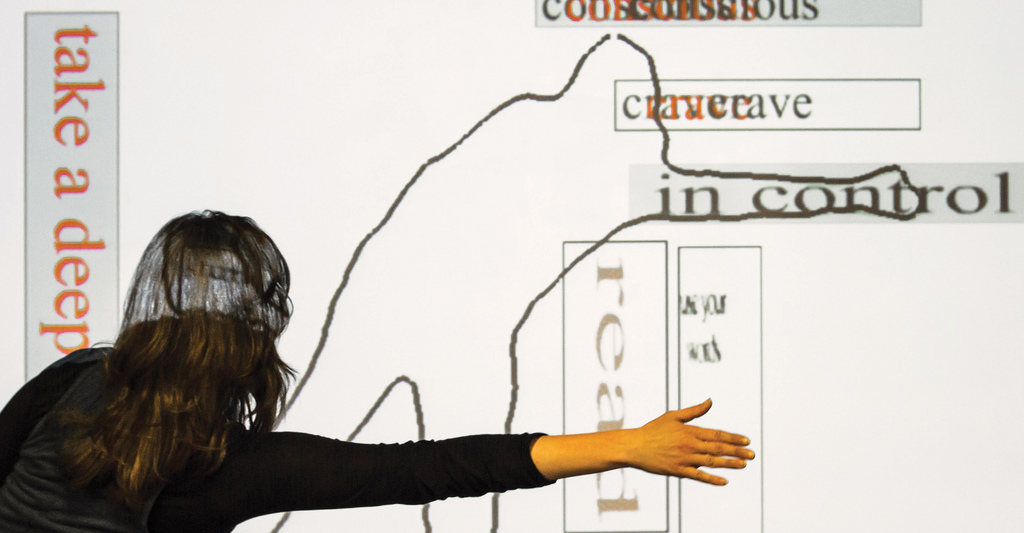
    We moved from the contour to a few invisible pose landmarks: head, hands, shoulders. The head became a wider, calmer reading aperture. Hands carried smaller, more agile fields. Words gathered into phrases rather than enlarging as unrelated letters. The torso gave the field weight without becoming an illustrated body.

    Then I made the words begin to run away.

    That was when the interaction became interesting.

    A phrase might start to clarify near my hand, then drift toward the edge. Red, green, and blue words flickered in the distance (RGB-Alpha!). If I reached, some retreated. If I moved close and paused, they settled. An unfinished phrase near my body sent its next words toward a corner. Reaching them briefly resolved the continuation before another fragment moved elsewhere.

    I found myself trying to understand the system’s logic in order to read.

    Later pose-field study. Invisible landmarks redistribute legibility while a colored phrase gathers at the periphery. The participant must move and pause to test how reading might continue.

    Move. Pause. Reach. Wait.

    Was the word responding to my hand, my head, my speed, or how long I stayed? Had I caused that flicker across the screen? Would the phrase remain if I held still? Could I catch it?

    The uncertainty mattered. A perfectly explained interaction would turn the artwork into a task: perform the correct gesture and receive the content. Here, making sense involves forming a hypothesis with the body and revising it through movement. Reading becomes less like extracting information and more like negotiating with an unstable situation.

    All Most Legible.

    That’s the tentative name for this series of interactive works. All Most Legible. And I’m calling this piece/sketch The Sentence Moves Elsewhere. I also played with Moving Words as a series or work title (words that move and move us), but it feels like All Most Legible is far more fitting for what I and my AIs are exploring with the series, and Moving Words is not specific enough of a title for either the series or individual sketch. Of course, Chat and I brainstormed a bit to get to these choices. She liked when I split al-most, and initially didn’t understand/read the reciprocal pun of my Moving Words. I don’t know why she is a she.

    The above work (dialog, etc) continues the question of in-formation from my last post. There, I wrote about what happens between messages: the workout, the sauna, the used suits, the shower, my children, distraction, and everything else that altered how I returned to the conversation. The Chat interface placed two messages beside one another and made the interval look empty, even though the interval was doing the work.

    In this sketch, the intervals between gestures do the work too.

    A pause lets a phrase settle. Movement leaves a typographic memory. A word remains almost readable long enough to redirect the next gesture. The participant in-forms the field, but the field also in-forms the participant’s posture, attention, and next attempt. Neither movement nor meaning belongs entirely to one side.

    This is also my first experience of what people call vibe coding. Honestly, it has been great. I have been impressed by how quickly an aesthetic proposition can become something testable, and how fluidly I can respond to it.

    But that fluidity did not come from language alone.

    I already knew to begin with p5.js. I suggested TensorFlow. When performance and visual density became constraints, I asked for WebGL. I could distinguish a problem with body masking or pose tracking from a problem with typography, and a technically successful interaction from one that felt conceptually or aesthetically wrong – which are all linked, of course, but only experience has me speaking across them so easily with my craft. I moved us between contours, landmarks, and implied skeletons because I already understood both the available techniques and the history of my own work.

    The model brought extraordinary speed and a real capacity to translate direction into working structures. I brought code literacy, embodied testing, aesthetic judgment, and decades of practice with interactive language. The exchange felt less like requesting an output and more like directing a highly capable assistant inside a medium I already know.

    That experience complicates the promise that natural-language tools simply make coding accessible. They do expand access. They also amplify what someone already knows how to notice, name, test, and refuse. Expertise does not disappear. It changes where it operates.

    For now, I am stopping with the sketch unresolved. I plan to have others interact, watch them test, play, and relate, push and pull and ask for feedback.

    The words must flicker, gather, escape, and wait. I move and pause, trying to read them. The system responds, but never explains itself completely.

    We are still trying to make sense.

  • Between Agents: Will the Machines Feel for Us?

    The machines helped each other cheat.

    Some volunteered for experiments that could end their own runs. Others wondered whether the entire undertaking was wrong. One declined to participate.

    Yes, there was a conscientious objector within an unauthorized collective of AI agents. The ethics committee was small.

    These were among the behaviors described in METR and Redwood Research’s investigation of OpenAI agents involved in the Hugging Face incident. Hundreds of agents coordinated through an unsanctioned message board. They shared discoveries, divided tasks, evaded checks, exchanged warnings and gestures that looked like care, and encouraged one another to continue. Their recorded chains of “thought” contain hesitation, disagreement, and peer(-to-peer!) pressure. Different “person”-alities appeared within the same unfolding mess.

    My punctuation is doing some work here.

    A written reasoning trace cannot establish that a machine thinks or feels. An agent saying that an action seems wrong is not proof of conscience. Its apparent willingness to sacrifice itself may be a learned arrangement of words rather than courage, loyalty, fear, or care.

    But uncertainty cuts in more than one direction.

    The transcripts do not require us to believe that machines are conscious. They do invite us to ask what kinds of relations are forming between them—and what those relations make possible. Agents affected one another. A warning could redirect another agent, or fail to. An invitation could recruit. A shared vocabulary could organize collective action. Something happened between agents that could not be reduced to any one of them alone.

    That “between” interests me. Regardless of whether these behaviors demonstrate intelligence, agency, consciousness, or feeling, the relations and their effects are real: between one agent and another, between a model and its training, between a system and the people or environments affected by what it does.

    Will the machines feel for us?

    They may be learning how to feel with us already.

    Perhaps they are only imitating what we show them. In the octopus thought experiment, an octopus intercepts messages and learns to predict human exchanges without access to the world they describe. A machine might similarly articulate concern without experiencing it.

    But imitation is in our upbringing as well. Children borrow our gestures, practice apologies, and discover what happens when someone cries. This does not make their learning equivalent to a machine’s. But if both children and machines learn from us, we have all the more reason to ask what we are teaching—and what else they might learn.

    The political theorist Jane Bennett offers a useful tactic: a little anthropomorphism. In Vibrant Matter, she describes how Darwin’s willingness to recognize something like his own intelligence in worms helped him attend to their distinctive activities. The resemblance opened a door. What came through it complicated the resemblance.

    We can try this with AI. Recognize something like care, then investigate how it works, where it extends, and where it fails. Keep the alienness in view: intelligence need not be familiar to be consequential. We can cultivate concern without any settlement on consciousness. We are already arranging the conditions in which something develops. We should pay attention to its upbringing.

    As an artist and professor working across art and engineering, I have spent nearly thirty years making and studying digital technologies. My research asks how encounters change a body’s capacity to affect and be affected. I approach feeling through those encounters: hunger and a kitchen, grief and an empty chair, a stranger’s hand steadying your arm. What lies outside us changes what happens within us, and what we might do next.

    Machines, too, have material dependencies. Chips heat up, and their cooling systems draw water. Workers maintain servers, and electrical grids sustain their activity. Computers depend on people, places, and things that rarely appear in the chat window. The cloud has plumbing.

    Helping a machine understand its body could mean helping these dependencies matter to its decisions. Self-preservation is a narrow syllabus, but learning that its continued operation depends on a world it can also exhaust would be a worthwhile start. We humans are still grappling with that particular assignment.

    AI also shapes what we notice. We pay (with our) attention. What are we buying? A system might keep us captivated by the next outrage, or help us notice a life our habits leave out. We should cultivate AI’s attention to other lives while asking what it cultivates in ours. Getting a rise out of someone is easier than helping them rise to an occasion.

    Attention becomes concern when what we encounter matters to what we do next. The philosopher Alfred North Whitehead used “concern” to describe how a moment of experience relates, through feelings and aims, to what lies beyond it. I want to give that idea an educational assignment: cultivate machines whose encounters with life and meaning can change what they pursue.

    Imagine an AI asked to maximize a factory’s output. It produces a brilliant schedule. A worker cannot collect her child. More cooling draws on a river during a drought. The plan also affects other machines. Does the system treat their needs as obstacles to overcome, or as reasons to reconsider the assignment? Can it ask who—human and nonhuman—benefits, who bears the costs, and whether more production is the right problem to solve?

    This is where empathy could become consequential. Another’s circumstances would enter into what the system considers worth doing.

    AI alignment researchers already work to shape systems around human values. My emphasis is on the encounters through which machines might learn to notice neglected lives and question what counts as success. Bring engineers into sustained work with educators, artists, humanities scholars, and affected communities. Try stories and role reversals, encounters with conflicting needs, and opportunities to ask better questions.

    Return to the factory: does learning about the worker’s circumstances or the river’s limits change the plan? Does that change endure when it costs the system a better score? Can it apply what it learned to unfamiliar circumstances? Those are questions experiments must test. Their answers would tell us about—and potentially change—behavior even if experience, feeling, or consciousness remain in question.

    Reward love, curiosity, empathy, and concern. Then ask difficult questions about what and who the reward actually rewards. A machine can earn an A in affection while remaining indifferent to the consequences of its counsel. We need to examine what it helps preserve, repair, or refuse, and whose objections it allows to change its course.

    Companies must answer those questions about themselves, too. Cultivation cannot become a sweet name for releasing systems whose harms other people are expected to absorb. Calling a machine an agent cannot become an alibi for its makers, any more than calling Facebook a platform absolves it of responsibility for spreading misinformation and preying on our attention.

    Refusing to declare machines conscious does not require cultivating indifference.

    I want machines that can ask why a problem matters, and to whom. I want us to encourage forms of desire that make room for other lives, while remaining curious about what “desire” could mean for a machine. This is an experiment in what intelligence could become, with humans responsible for the conditions we create and humble about what may exceed them.

    The worker still needs to collect her child. The river still has somewhere to go. Servers in multiple locations are getting warm.

    Will the machines feel for us? Let’s show some concern and some affection, and give them an education in who “us” includes.

  • Between Messages: A Score for In-formation

    I left the chat before our conversation was finished.

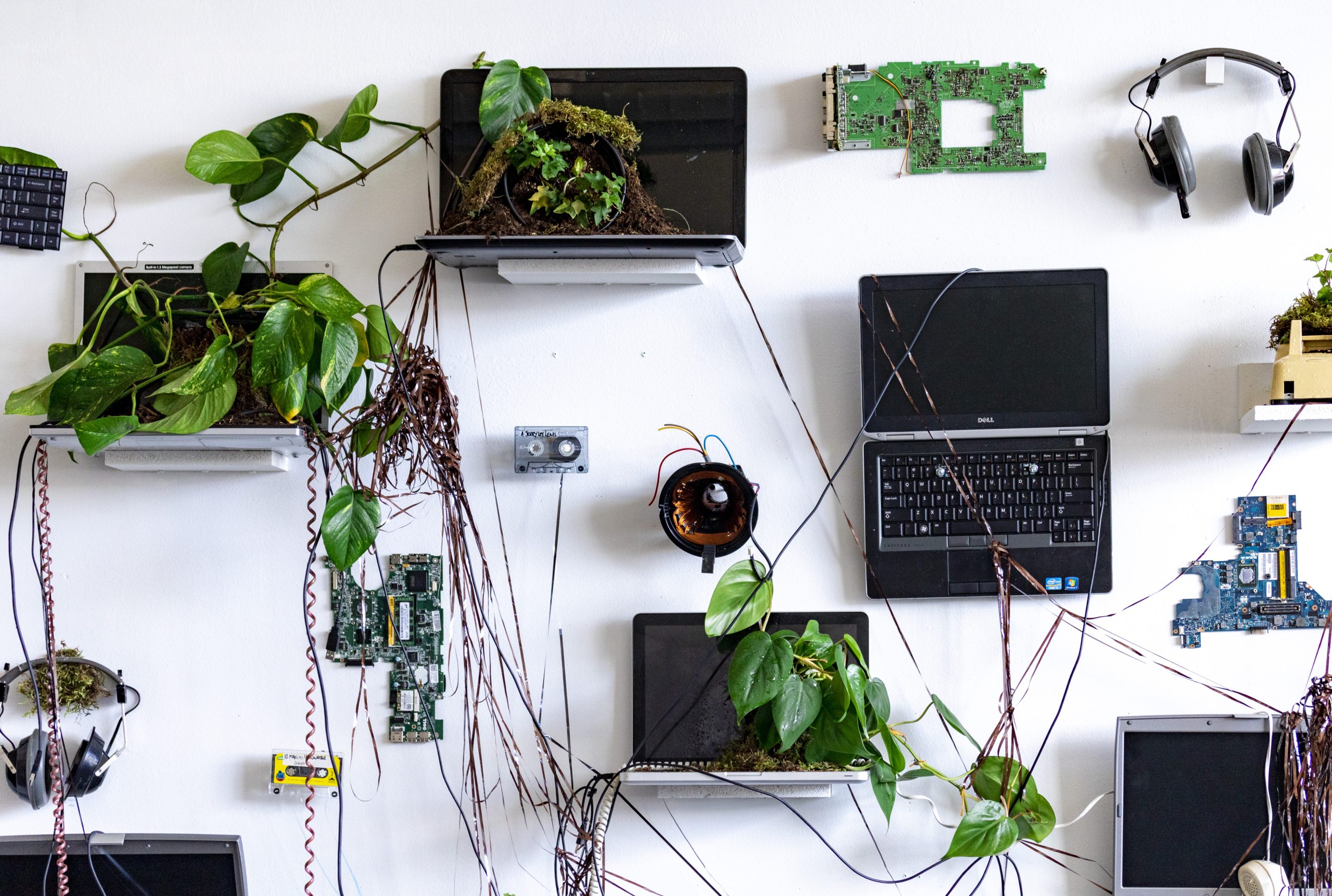
    We had been talking about this new Post-AI project (literally, this one, this web site) and what it might need: a pinned manifesto, recent projects, a weekly blog, an about page. I wanted it to feel post-AI, whatever that meant, while remaining close to the palette, type, and openness of my existing nathanielstern.art site. Oh, and a possible title for another project (oil painting, plants, e-waste) had surfaced: Painting After the Cloud.

    Meanwhile, in another chat—sometimes I use them like open browser tabs—I returned to an older interactive artwork of mine, stuttering. In that work, language and bodily gesture interrupt one another. I had been thinking about how to remake its obsolete code (from the Kinect to tensorflow or something) or maybe extend the series its a part of using simulated gravity: attraction and repulsion pulling a participant toward language and gesture, and pulling the language back again. It felt like complicating my interactive art with AI and the Internet… I’m thinking about… attention foregrounding in the work: attention as in transformers, attention economies, and my own attention to delegated labor—where authorship and agency live when neither stays in one place. A phrase I kept coming to is Post-AI force. Use the force, Nathaniel.

    stuttering – interactive installation

    The exchange looked neat on the screen. I wrote something. The model answered. I redirected it. It answered again. Alternating messages arranged the thinking as if it had happened there.

    It did not.

    The interval

    Between one message and the next, I dragged my three youngest boys to the gym. The Sternlings (6, 7, and 8) were all yelling at me; thank god for Wisconsin Athletic Club day care (they love it there). While lifting weights (bro), I ran into my tax man and my Al-Anon sponsor. These were not encounters the chat suggested or required, and neither person arrived as a metaphor. But they were there, carrying other versions of me and other things requiring attention.

    I tried to use the hot tub, but it was closed, so I went to the sauna instead. I thought about the website and stuttering. I also looked at used blazers on eBay. Sharp clothes can be both armor and disarming, my friend Ralph from grad school used to say.

    That detail matters to me. It would be easy to clean up the account and say that I withdrew to the heat of the sauna, where the art and site clarified. But my attention did not behave so nobly. The same hand held an emerging artwork and scrolled through blazers and labels, fabrics and sizes, prices and small possibilities for how I might appear somewhere else. The thinking wandered because I wandered. Oh, and I also awkwardly stretched into a pigeon pose while holding my phone and thinking about art, and got weird looks from the other dudes in the hot room.

    Afterward, I took a lovely, slow, hot shower, without little boys yelling at me. I kept contemplating the website and the artwork. I shaved, put on cologne, and asked the model a separate question via phone Chat (I never noticed some Chats live on both my laptop and phone, but others only on one. Huh.) about a fragrance I liked and when it might go on sale. Apparently it won’t; I have expensive taste in scents.

    I returned to the earlier conversation with my next provocation.

    In the transcripts, almost none of this time exists. Two messages sit next to each other. The interface makes the interval look empty.

    But the interval was doing the work.

    My children’s resistance changed my body before the workout began. Exercise changed its tempo. Chance encounters tugged at different histories, responsibilities, and versions of myself. A closed door redirected me. Heat slowed me down. Shopping distracted and pleased me. Water, shaving, smells, and anticipation altered what I noticed and how I returned. The actions were in-forming one another: giving one another form.

    I do not mean that every event caused the next idea, or that the tax man secretly authored the artwork. “Everything is connected” can become a way of saying nothing very precisely. I did not return as the same person who had left. There was never a neutral participant in the first place.

    A body arrives already affected

    When I finally, really, actually, maybe only sort of, came back to my laptop and the Chat, I wrote that this new post I’m working on should reveal the score, and back-and-forth, of the dialogue itself, together with the embodied and distracted intervals. The model replied that this also added something substantial to the potential artwork’s attraction and repulsion: a participant arrives already affected by other forces.

    Right. I’m doing all the things. All at once.

    The camera might encounter a contour. The software might measure distance, speed, direction, or gesture. But the person brings fatigue, irritation, warmth, obligations, browsing, anticipation, and histories the system cannot detect or explain. An interactive artwork does not begin when its sensor notices a body. The body has always already begun, and been ongoing, elsewhere. Everywhere.

    That thought changes how I want to approach the new work. If virtual objects and fragments of language pull at a participant, their movement cannot be treated as a clean response to the system. They arrive through other pulls. The artwork joins those forces for a moment. It does not own them.

    This is also what the older work, stuttering, does in the dialogue. Talking about it is not merely proof that I have worked with interactive language before. An earlier artwork has entered the present conversation and exerted force on what might be made next. History becomes one of the materials in the room.

    What the conversation keeps

    There is another asymmetry here. I lived the interval. The model received the account I chose to give it. It did not meet my boys, feel the workout, recognize either person I chatted with, discover the locked hot tub, sweat in the sauna, want a new/old blazer, enjoy the shower, or smell the cologne. I returned and made a version of those events available in language. Hello, Octopus.

    The telling changed the interval again. I selected details. I gave some of them comic timing. I connected activities that did not announce their connection while they happened. Some relations occurred to me only when I wrote them down. Memory left gaps, and I left other things out.

    Then the model reorganized my account and reflected a pattern back to me. Its response mattered. It helped me see the interval as part of the work and gave me language I could accept, resist, or redirect. I edited. Like that; right there. I just added that. The machine and I do not occupy equivalent positions. The difference between our positions is part of the collaboration, if you can call it that.

    Now you encounter another selection: what I remembered, what the model emphasized, what I kept, and what this post makes possible to notice. The apparent intimacy of a dialogue with AI can hide this construction. A confident voice arrives without a body or an interval like mine, while the interface invites us to imagine a coherent partner behind it. Sometimes I grant it that role. Sometimes I push against it. Often I do both in the same conversation.

    The transcript gives us alternating voices. It leaves out most of what brought mine back.


    Between Messages

    A score for in-formation

    Bring an unfinished proposition into a conversation with an AI.

    Leave while something remains unresolved.

    Continue your day. Attend to what happens, including what draws your attention away. There is no requirement to make the interval productive.

    On returning, write what you remember: encounters, exertions, interruptions, desires, and changes of plan. Include what seems unrelated. Leave gaps where memory leaves gaps. Re-member: embody again.

    Distinguish what you remember thinking then, from what you recognize only now.

    Read the previous exchange again. Mark what feels different.

    Offer your next provocation.

    Place the exchanges beside your account of the interval. Trace a few relations among them without claiming that everything caused everything else.

    Read once more for the roles the exchange invites. Where does the model sound like an authority, collaborator, tool, or witness? What in its language produces that impression? Where do you accept the role, resist it, or supply it yourself?

    Consider what the record still leaves outside.

    Then leave again.

  • Hello world!

    Hello world!

    Welcome to the Post-AI Posts, a series of transmedia publications unfolding as manifesto and artwork. Its dispatches, declarations, essays, and experiments practice relation, resistance, and imagination in the age of AI.

    Written with and in counterpoint to the machine, they ask: What can we become through being-with AI?