The first of the Post AI Posts, the Manifesto for Post-AI Art, asked what we can become through being-with AI. For this second Post, I’m releasing an artwork you can spend time with: The Sentence Moves Elsewhere, part of my new All Most Legible series. It runs in a browser, and requires a webcam, a recent machine, a willingness to move and be moved, and a bit of time. (I haven’t tested on enough machines to give recommended specifications, but it does require a bit of processing power.)
The Sentence Moves Elsewhere has been taking shape Between Posts. Between Messages followed what happens outside the chat, and the changes we bring back because of it. Between Gestures began by asking how AI words might meaningfully invite movement and change, and those led to the work presented here.
Artist Statement
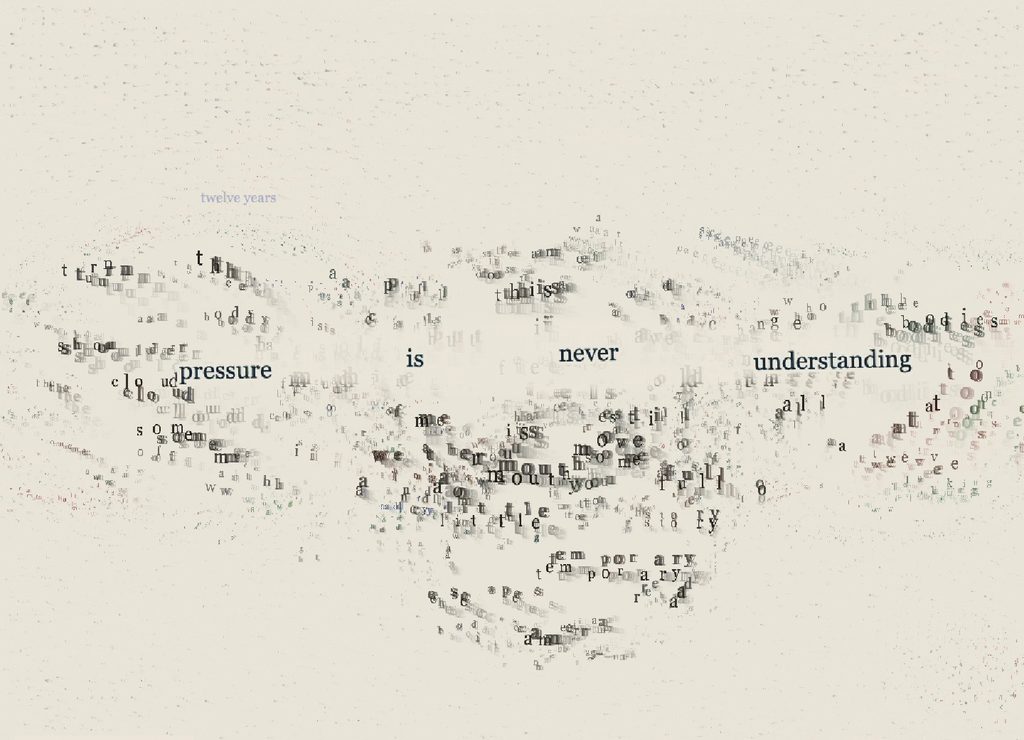
The Sentence Moves Elsewhere is a browser-based interactive artwork where we use our bodies to gather, stretch, and scatter a poem. Dark, serifed characters threaded with red, green, and blue swell across a pale, paper-like ground. A webcam tracks our head, torso, and hands, creating force fields where sentences become readable, then drawing us elsewhere. We move and are moved.
One hand gathers a knot of words. A second opens them into a line: the distance between our hands becomes a space for legibility. We can adjust its slope, as we learn to follow and lead. But holding takes work. An arm tires; another phrase catches the eye. Reach toward it, and one end loosens. Lower a hand, and the line folds toward the other. What we read changes how we hold ourselves; what we want to read changes how we dance.
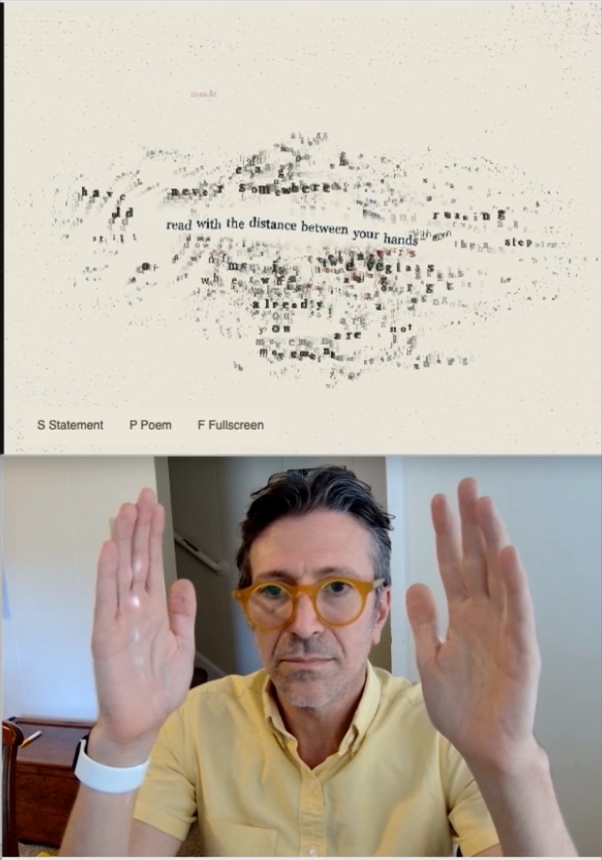
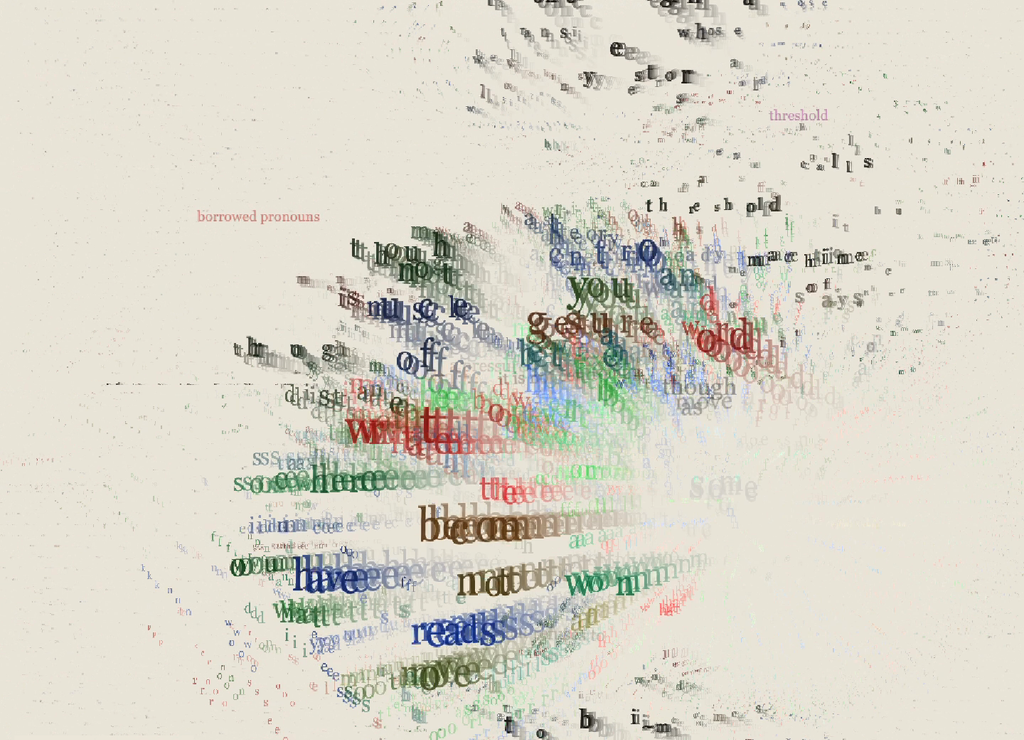
At the edges, colored words offer other beginnings: time, flesh, a machine, a question. Touch opens longer phrases; a quick reach sends letters bursting outward. Fans of language gather and spread. Released fragments linger, influencing where another invitation appears. We move between reading and reaching, thinking and play. An unfinished thought has weight.
A turn of a phrase can turn our heads, and vice versa. We stretch the meaning of a word. We reach the end of a sentence. We lose our place in the reading. We grasp its importance, and hold on tight.
The underlying poem asks what a body is, and where it begins: in an ache, a remembered age, a wrist the camera recognizes. The gap between our hands becomes punctuation; hesitation gives a phrase duration. A sentence takes shape, and a reader becomes a temporary choreography of attention.
Part of my new All Most Legible series, the work continues my Body Language installations (2000–2013), where writing, speaking, and listening emerge alongside bodies and their possibilities. Here, AI participates in two linked encounters: my production of the work, and your interaction with it. Tracking models sense where your body is in real time; my workflow moves between large language models, AI-assisted “vibe coding,” and my own art and software expertise. I return computational proposals to embodied testing. A technically successful response can feel wrong; an unexpected movement can change the work’s direction. Making and interacting each develop capacities and habits, while exposing limits that can prompt another revision or gesture.
Each encounter also includes what computation leaves out. Tracking models infer bodily points; language models respond to the context I supply. Neither encounters the history in a shoulder, knows why a hand moved, or lives the interruption when my kids ask for snacks while we code. A camera frame and a chat box select what enters computation; what falls outside them still shapes the work. Our flesh and memories exceed the models’ evidence, even as we adjust to their responses. This is what I mean by an ecological aesthetic: the camera, the model, the room, and our bodies make some ways of sensing possible and hide others, whether we are making the work or playing it.
The Sentence Moves Elsewhere brings the question of my Post-AI Posts into our hands: what can we become through being-with AI? Every interface decides which gestures count and what becomes legible. This one lets you feel a habit forming, and try something else. As the poem puts it, “if the words scatter you have not failed / if they gather you have not won.”
Try the work
This is a beta release of The Sentence Moves Elsewhere. I’d love to hear what it asks of your body: where you linger, what draws you away, whether you find yourself reading differently. I’d also like to know where the technology gets in the way. Tell me your device specs and browser, what happened, and what you were trying to do. Your encounters can help shape what comes next.